What Is Rope Access Facade & Cladding Repair?
The external envelope of a building takes a beating. Wind, rain, UV, thermal cycling, pollution, and simple age all degrade cladding systems, joints, fixings, and finishes. When things start to fail — a cracked render panel, a blown cladding sheet, a corroded bracket, a missing fire barrier — somebody needs to get up there and fix it. The question is how you access the work.
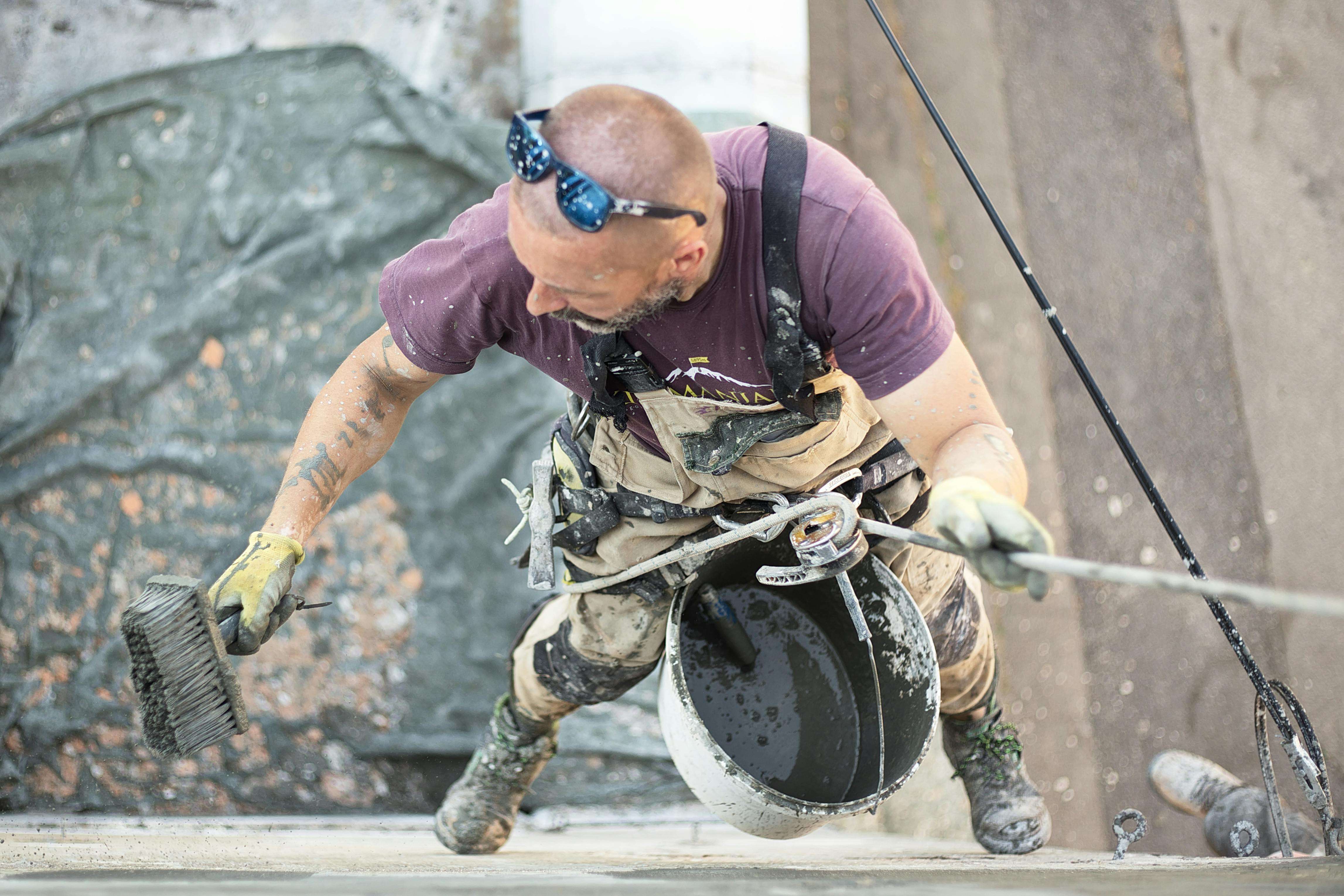
For targeted repairs on buildings above four storeys, rope access is almost always the most practical and cost-effective answer. A two or three-person team can mobilise in days, rig from the roof, and carry out repairs to specific locations on the facade without wrapping the entire building in scaffold. The repairs might take two days; the scaffold to reach them would take two weeks to erect and another two to dismantle, at a cost that dwarfs the repair work itself.
Since Grenfell, facade and cladding repair has become the single largest growth area in the UK rope access sector. Thousands of buildings require cladding surveys, fire barrier remediation, panel replacement, and sometimes complete re-cladding. Rope access provides the access for much of this work — particularly the survey, investigation, and targeted repair phases that precede any decision about full remediation.
Types of Cladding and Common Defects
Rainscreen Cladding
Rainscreen systems — where an outer skin of panels is mounted on brackets with a ventilated cavity behind — are the most common cladding type on modern commercial and residential buildings. Panel materials include aluminium composite (ACM), high-pressure laminate (HPL), terracotta, zinc, copper, fibre cement, and natural stone.
Common defects include:
- Panel damage — impact damage, corner cracking, delamination (particularly ACM panels), UV degradation, colour fading
- Bracket and fixing failure — corrosion, loosening, thermal movement fatigue
- Missing or degraded cavity barriers — fire safety critical; a major focus since Grenfell
- Joint sealant failure — allowing water ingress into the cavity
- Insulation degradation — water-damaged, compressed, or displaced insulation boards
Rope access technicians can remove and replace individual panels, replace brackets and fixings, install or replace cavity barriers, and renew joint sealants — all without disturbing the rest of the facade. This targeted approach is far cheaper than full scaffold access when the defects are localised.
Curtain Walling
Curtain wall systems — typically aluminium-framed glazing and spandrel panels — are common on commercial buildings from the 1960s onward. They deteriorate through:
- Gasket and seal failure — the single most common curtain wall defect, causing water ingress
- Thermal break degradation — older systems without thermal breaks suffer condensation and heat loss
- Transom and mullion corrosion — particularly at joints and where drainage channels block
- Spandrel panel damage — cracking, fading, or delamination
- Structural silicone failure — on structural glazing systems, the silicone bond is critical
Rope access allows targeted repair of specific bays, replacement of gaskets and seals, and investigation of systemic problems without scaffolding the entire facade. For curtain wall refurbishment, the repair team can work bay by bay down the building.
Render and Insulated Render Systems
External wall insulation (EWI) systems — insulation boards fixed to the substrate and finished with a polymer-modified render — are increasingly common on both new builds and retrofit projects. Defects include:
- Render cracking — from substrate movement, impact damage, or inadequate reinforcement mesh
- Render debonding — the render separates from the insulation, typically starting at edges and corners
- Insulation board failure — water-damaged boards lose their thermal performance
- Missing or damaged beads and trims — allowing water behind the render at edges and openings
- Biological growth — algae and moss on north-facing or sheltered elevations
Render patching and crack repair is well-suited to rope access. Technicians can cut out damaged sections, replace insulation if needed, apply new render with colour-matched finish, and the repair blends into the surrounding area. For widespread cracking or debonding, a full condition survey by rope access first determines whether targeted repairs or complete re-rendering is more cost-effective.
Brickwork
Older buildings and many new-build residential developments use brick facades. Common defects include:
- Pointing failure — mortar joints erode, crack, or fall out, allowing water ingress
- Cracking — structural movement, thermal expansion, or lintel failure
- Spalling bricks — frost damage, sulphate attack, or manufacturing defects
- Failed cavity trays and DPCs — causing water to bridge the cavity
- Staining — efflorescence, iron staining from embedded fixings, biological growth
Repointing, brick replacement, crack stitching, and masonry cleaning are all carried out routinely by rope access. For extensive repointing on a tall building, scaffold might be more efficient — but for localised repairs and investigation, rope access is the clear choice.
Post-Grenfell: Building Safety Act and Cladding Remediation
The Building Safety Act 2022 fundamentally changed the obligations of building owners and managers regarding facade safety. For higher-risk buildings (residential buildings over 18 metres or 7+ storeys), there are now specific duties including:
- Registration with the Building Safety Regulator
- Safety case reports documenting building safety risks and mitigation measures
- Mandatory occurrence reporting for safety-related defects
- Ongoing assessment of the building’s external wall system
For buildings with combustible cladding or inadequate fire barriers, remediation is not optional — it’s a legal requirement. The question is how quickly and how cost-effectively it can be done.
The Inspection-to-Repair Workflow
Most cladding remediation projects follow a similar sequence:
- Desktop study — review original design drawings, specifications, and any previous survey reports to understand what the building envelope should consist of
- Rope access survey — close visual inspection of the entire facade, with intrusive investigation at representative locations (removing panels to inspect the cavity, insulation, and fire barriers behind)
- Laboratory testing — samples of cladding panels, insulation, and fire barriers sent for fire testing to determine combustibility
- Fire engineering assessment — a fire engineer evaluates the overall external wall system and determines what remediation is needed
- Remediation specification — the engineer or architect specifies the scope of works
- Remediation works — ranging from targeted fire barrier installation to complete re-cladding
Rope access is the standard access method for stages 2 and 3, and is increasingly used for the remediation works themselves — particularly where the scope is targeted (fire barrier installation, panel replacement in specific zones) rather than a full strip-and-re-clad.
Funding and Leaseholder Protections
The Government’s Cladding Safety Scheme and Building Safety Fund provide funding for eligible remediation works on residential buildings. The application process requires detailed survey information and cost estimates — which means a thorough rope access survey is typically the first step. For Section 20 consultation on leasehold buildings, the survey report needs to be detailed enough to withstand scrutiny at a First-tier Tribunal.
Targeted Repairs vs Full Scaffold
This is the key economic question for most facade repair projects: do you scaffold the whole building, or use rope access for targeted work?
When Rope Access Wins
- Localised defects — a handful of damaged panels, specific areas of cracked render, individual failed sealant joints. Scaffolding a 15-storey building to replace three panels on the eighth floor is absurd. Rope access gets a technician to those panels in an hour.
- Investigation work — opening up cladding at representative locations, checking cavity barriers, taking samples. This work is scattered across the facade and doesn’t need continuous platform access.
- Emergency repairs — loose panels after a storm, water ingress causing damage to occupied spaces, safety-critical defects identified during inspection. Rope access can mobilise in 24–48 hours. Scaffold takes weeks.
- Phased repair programmes — where the budget doesn’t stretch to fixing everything at once, rope access allows you to prioritise the most critical repairs and tackle them in affordable phases.
When Scaffold Makes More Sense
- Full re-cladding — if every panel on the building is being replaced, scaffold provides a continuous working platform that’s more efficient for this type of repetitive, large-scale work
- Low-rise buildings — below four storeys, scaffold is quick and cheap to erect, and provides a comfortable working platform for extended repair work
- Combined works — if the building is being scaffolded anyway for another purpose (e.g., roof works), adding facade repairs to the same scaffold mobilisation makes sense
Cost Comparison Example
A 12-storey residential building with fire barrier deficiencies identified at 40 locations across all four elevations:
| Approach | Access cost | Repair cost | Total | Programme |
|---|---|---|---|---|
| Full scaffold | £60,000–£90,000 | £25,000–£40,000 | £85,000–£130,000 | 12–16 weeks |
| Rope access | Included in day rates | £35,000–£55,000 | £35,000–£55,000 | 3–5 weeks |
The rope access approach costs roughly half and delivers four times faster. The repair cost per location is slightly higher for rope access (less efficient per fix than working from a platform), but the access savings more than compensate.
Working With Building Safety Managers
The Building Safety Act introduced the role of Accountable Person and Principal Accountable Person for higher-risk buildings. These individuals have legal responsibilities for building safety, including the external wall system. If you’re a building safety manager working through a remediation programme, here’s how rope access contractors fit into the picture:
- Survey reports feed directly into your safety case — ensure the contractor understands the level of detail you need and the format required for your building safety documentation
- Risk-based prioritisation — a good rope access survey will classify defects by severity, allowing you to prioritise remediation spending on the most critical items
- Evidence trail — photographs, test results, and as-built records from the repair works should be captured and stored as part of your golden thread of building information
- Ongoing monitoring — rope access provides an affordable way to carry out periodic re-inspection of completed repairs and remaining facade areas
Health and Safety
What to Expect From the Contractor
- Site-specific RAMS addressing the specific cladding type, work activities, and site conditions. For remediation works, this should include asbestos awareness (older buildings may have asbestos-containing materials in the cladding system), safe handling of replacement panels, and working at height near occupied windows.
- IRATA company membership and valid technician ID cards for every person on the ropes.
- CDM compliance — for remediation projects, Construction (Design and Management) Regulations 2015 apply. The contractor should understand their duties as Principal Contractor or Contractor under CDM.
- Insurance — public liability (minimum £5 million; £10 million for residential remediation work is advisable), employers’ liability, and professional indemnity where the contractor is producing survey reports or design input.
- Waste management — removed cladding panels, insulation, and fire barrier materials must be disposed of correctly. The contractor should provide waste transfer notes and confirm appropriate disposal routes, particularly for materials that may be classified as hazardous waste (e.g., certain insulation types).
Residents and Occupants
Facade repair work on occupied residential buildings needs careful management. Residents should receive advance notice of:
- Dates when work will be outside their windows
- Any need to keep windows closed (particularly during sealant application or render work)
- Exclusion zones at ground level
- Noise expectations — power tools for panel removal, render cutting, and surface preparation generate noise, though the duration at any single location is typically short
Rope access work is inherently less disruptive than scaffold-based work — there’s no structure blocking windows and light for weeks, no scaffold boards providing a platform outside private spaces, and no prolonged noise from scaffold erection and dismantling.
Get a Quote
We connect you with specialist rope access facade and cladding repair contractors across the UK. Whether you need a cladding condition survey, fire barrier remediation, targeted panel replacement, or render repairs, tell us about the building and the work required and we’ll match you with experienced teams who understand the technical requirements and regulatory context. No obligation — initial estimates can usually be provided from building information, photos, and a phone call.