What Is Lightning Protection?
A lightning protection system (LPS) is a network of components designed to intercept a lightning strike and conduct the energy safely to ground, preventing damage to the building structure, electrical systems, and — most importantly — the people inside.
The system has three main parts. At the top, you have the air termination network — a grid of conductors, rods, and tapes across the roof that acts as the strike point. Running down the building are down conductors, typically flat copper or aluminium tape fixed to the facade at regular intervals. At ground level, the earth termination system disperses the energy into the ground through buried electrodes.
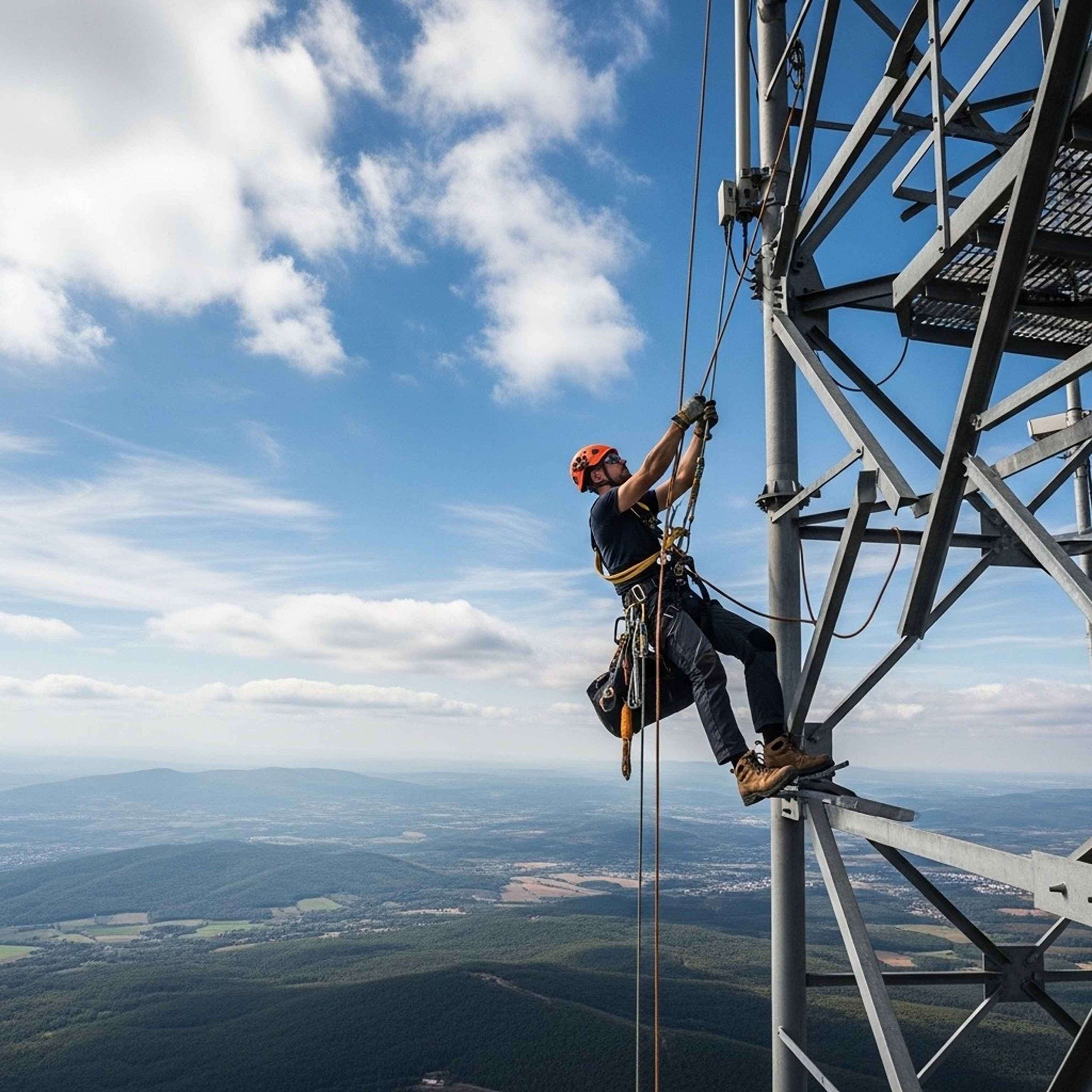
Rope access is a natural fit for lightning protection work. The system literally runs from the highest point of a building to ground level, and every component needs to be securely fixed to the structure. A rope access team can start at the ridge and work their way down, installing air terminals, running conductor tape, making bonding connections, and testing joints as they go — all without a single scaffold tube being erected.
Why Buildings Need Lightning Protection
There is a common misconception that lightning protection is optional or only needed for very tall buildings. The reality is more nuanced.
BS EN 62305 is the current standard governing lightning protection in the UK. It uses a risk assessment approach — you calculate the probability of a strike based on the building’s height, location, construction type, contents, and occupancy. For many commercial and public buildings, the assessment concludes that protection is required.
Beyond the standard itself, there are several drivers:
- Insurance requirements — many commercial insurers require a compliant LPS as a condition of cover, particularly for buildings with sensitive equipment, flammable contents, or high occupancy. If your building suffers a lightning strike without adequate protection, your insurer may refuse the claim.
- Building regulations — Approved Document H and various British Standards reference lightning protection requirements. New builds of certain types must include an LPS from the outset.
- Duty of care — if you own or manage a building where people work, visit, or live, you have a responsibility to manage foreseeable risks. Lightning is foreseeable.
The consequences of an unprotected strike range from minor (tripped circuits, damaged electronics) to catastrophic (structural fire, explosion in buildings with flammable atmospheres). Church spires, in particular, have been catching fire from lightning strikes for centuries — it is one of the most common causes of heritage building fires in the UK.
What Buildings Need It Most
While any building can benefit from lightning protection, some are higher priority:
Tall and exposed buildings — height is the single biggest risk factor. A 30-metre building on flat terrain is far more likely to be struck than a 10-metre building surrounded by taller neighbours.
Heritage and listed buildings — churches, cathedrals, historic houses, and public monuments. These are often tall, exposed, and irreplaceable. A fire caused by a lightning strike to an unprotected Grade I listed church is a disaster that no amount of insurance money can undo.
Buildings with sensitive contents — data centres, hospitals, telecommunications facilities, substations. Even an indirect strike can induce surges that destroy sensitive equipment.
Buildings with flammable or explosive atmospheres — chemical plants, fuel storage, grain stores. Lightning protection is typically mandatory for these.
Schools, care homes, and public buildings — high occupancy plus duty of care makes protection sensible even where the risk assessment doesn’t strictly mandate it.
How Rope Access Compares to Other Methods
Lightning protection installation is one of those jobs where the access method can cost more than the actual system being installed. Here is how the options stack up.
Scaffolding is the traditional approach, and for a straightforward rectangular building it can work. But the cost is substantial. Scaffolding a four-storey commercial building typically runs between £15,000 and £40,000, and it needs to stay up for the duration of the install — usually one to three weeks. For complex buildings with multiple roof levels, towers, or setbacks, the scaffold design becomes complicated and the cost escalates rapidly.
Cherry pickers and MEWPs can work for some down conductor routes on simple facades, but they are limited by ground conditions, access width, and reach. They cannot access rooftops for air termination work, and they struggle with anything above about 25 metres.
Rope access eliminates both problems. A team of two or three IRATA-certified technicians can mobilise in a morning with all the equipment they need. They work from the roof down, installing air terminals, running tape, making connections, and moving across the facade without any ground-level plant. For a typical four-storey building, the access cost saving compared to scaffolding is usually 40-60%.
The time saving is equally significant. Where a scaffolded installation might take three weeks including erection and dismantling, a rope access team can often complete the same work in five to eight days.
Installation: What the Work Involves
A lightning protection installation typically follows this sequence:
Design — a specialist LP designer produces the system layout based on the risk assessment and BS EN 62305. This determines the air termination layout, the number and routing of down conductors, bonding requirements, and earth termination specifications.
Air termination network — on the roof, the team installs a grid of conductor tape (usually 25mm x 3mm copper or aluminium) supported by roof conductors, along with vertical air rods at high points, corners, and edges. On flat roofs, the tape is clipped to purpose-made stands. On pitched roofs, ridge and hip conductors are fixed along the leading edges.
Down conductors — flat tape runs vertically down the facade from the air termination network to ground level. The number of down conductors depends on the building perimeter — BS EN 62305 specifies maximum spacing. Each route is fixed with purpose-made clips at regular intervals, with test clamps installed at accessible height for future testing.
Bonding — all metallic items on or in the building that could provide an alternative path for lightning current must be bonded to the LPS. This includes metal cladding, railings, satellite dishes, extract fans, pipe work, and structural steel.
Earth termination — at the base of each down conductor, an earth electrode (usually a driven rod or buried tape) disperses the energy into the ground. Earth resistance testing confirms each electrode meets the required resistance value.
For heritage buildings, the installation needs extra care. Conservation officers will have views on conductor routing, fixing methods, and materials. Copper tape on a limestone facade might be appropriate; on a flint church tower, it might need to be routed differently. Rope access technicians working on heritage buildings need to understand both the LP requirements and the conservation constraints.
Testing and Maintenance
Installing a system is only half the story. BS EN 62305 requires ongoing testing to confirm the system remains effective:
Annual visual inspection — a walk-round check of all visible components. Are conductors still securely fixed? Has any tape been damaged by building works? Are test clamps accessible? Have any new metallic additions been made to the building that need bonding?
Periodic full electrical test — typically every 11 months for critical structures, or every two years for standard buildings. This involves continuity testing of every conductor route, earth resistance measurement at every electrode, and checking all bonding connections. Results are recorded on BS EN 62305-compliant test certificates.
Rope access is particularly cost-effective for testing. A visual inspection might take a two-person team half a day. A full electrical test on a medium-sized building might take one to two days. Compare that with erecting scaffolding every year just to check a few clips and take some resistance readings — the numbers simply do not make sense.
Many building managers set up annual maintenance contracts where the rope access team visits once a year to carry out the visual inspection, full electrical test, and any minor repairs in a single visit. This keeps the system compliant and catches small problems before they become expensive ones.
Typical Costs
Lightning protection costs vary significantly depending on building size, complexity, and the level of protection required. As a rough guide:
New installation (four-storey commercial building):
- System materials: £3,000-£8,000
- Rope access installation: £4,000-£12,000
- Earthing: £1,500-£3,000
- Design and certification: £1,000-£2,500
- Total: £9,500-£25,500
Compare that with the same installation using scaffolding, where the access alone might add £15,000-£30,000 to the project cost.
Annual testing (same building):
- Rope access visual inspection + full electrical test: £800-£2,000
- Versus scaffolded testing: £5,000-£15,000+
The difference is stark. Over a 10-year maintenance cycle, the cumulative saving from rope access testing alone can exceed the original installation cost.
Heritage buildings — churches, listed buildings, and complex structures will be at the higher end of these ranges due to longer installation times, specialist fixing methods, and the need for conservation-sensitive approaches.
Working with Specialist LP Contractors
Lightning protection is a specialist discipline. The rope access technicians who install and test systems need to understand BS EN 62305 in detail, be competent in electrical testing, and know their way around LP components.
In practice, this work is often carried out one of two ways:
- Specialist LP companies with rope access capability — some lightning protection contractors have IRATA-trained staff or subcontract rope access teams directly.
- Rope access companies with LP experience — experienced rope access firms who regularly install and test lightning protection systems, working from designs provided by the client’s LP consultant.
Either approach works. The key is ensuring that the people doing the work understand both sides — the rope access techniques and the lightning protection requirements. A rope access team that has never installed an LPS will need supervision from someone who has.
Health and Safety
Lightning protection work at height is governed by the Work at Height Regulations 2005. Rope access operations must comply with IRATA guidelines, and all technicians must hold current IRATA certification at the appropriate level.
Specific considerations for LP work include:
- Live systems — if the building already has a lightning protection system, it could carry a strike during the work. Risk assessments must address this, and work may need to be suspended during thunderstorm warnings.
- Electrical testing — technicians must be competent in the use of earth resistance testers and continuity testing equipment.
- Heritage buildings — method statements should detail how the building fabric will be protected during installation.
- Permits and notifications — listed building consent may be required for visible external conductor routes. Planning conditions sometimes apply.
You should expect to receive a detailed method statement and risk assessment before any work begins, along with IRATA certificates for all personnel and public liability insurance documentation.
Get a Quote
If your building needs a lightning protection system installed, tested, or repaired, our directory connects you with experienced rope access contractors who specialise in this work. Tell us about your building and what you need, and we will match you with vetted, IRATA-certified teams who can provide a competitive quote. No obligation, no fuss — just a straightforward route to getting the job done properly.