What Is Rope Access Painting & Decorating?
External painting at height is one of those jobs where the access method costs more than the paint. Scaffolding a ten-storey building to repaint the facade can easily cost £30,000–£60,000 before a single brush stroke — and that’s just for the scaffold. The painting itself might cost half that. Rope access flips the economics: the access is built into the team’s day rate, the paint goes on the wall, and you’re done in a fraction of the time.
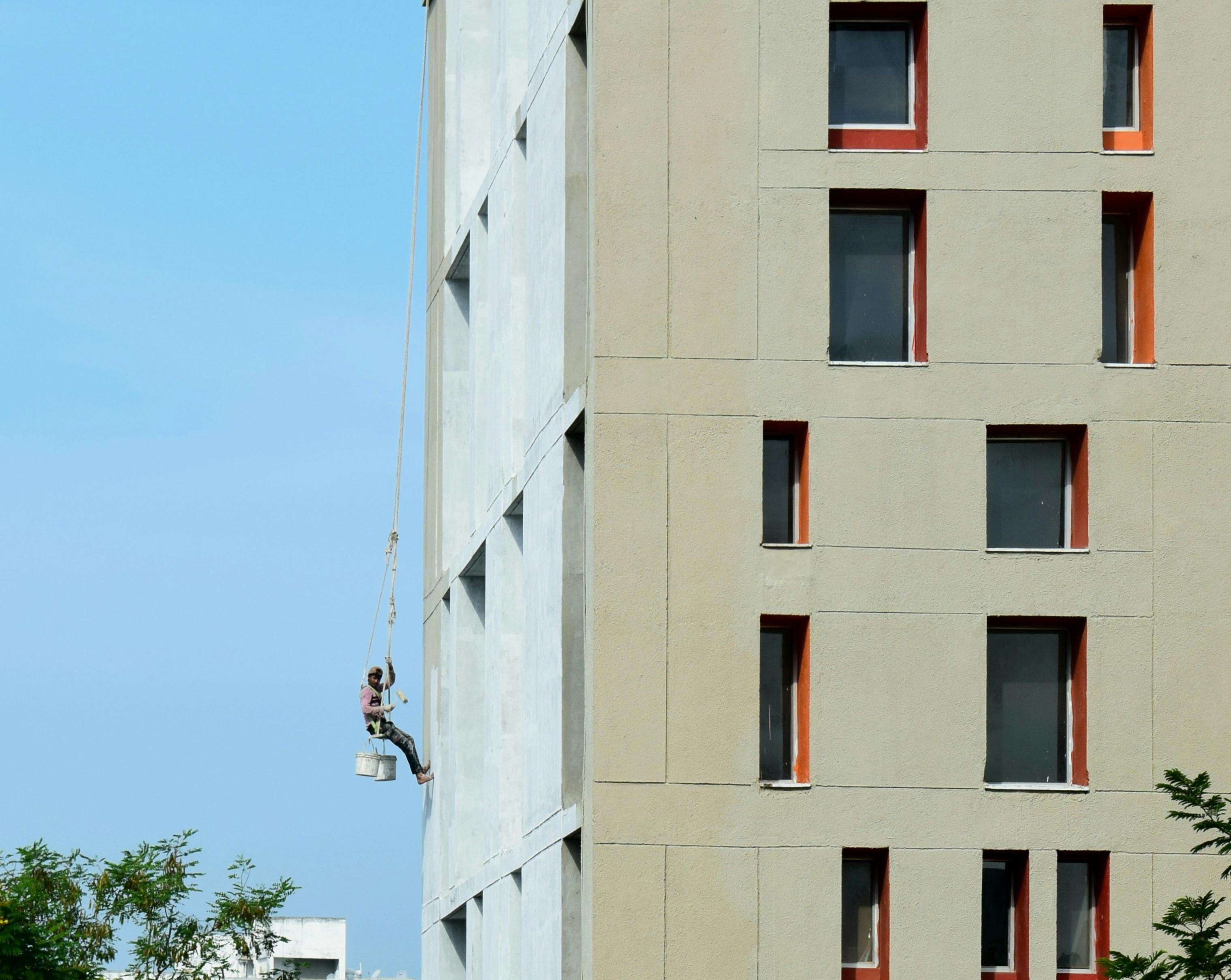
Rope access painters work from twin-rope systems anchored at roof level, carrying paint, rollers, brushes, and spray equipment in tool bags and buckets secured to their harness. They can reach every part of a facade — including the awkward bits that scaffold struggles with, like deep reveals, soffits under canopies, and areas behind downpipes. A team of three or four IRATA-certified painters can repaint a medium-sized commercial building in a week or two. The same job via scaffold takes weeks of erection and dismantling wrapped around the actual painting work.
This covers everything from straightforward masonry repainting to specialist steelwork coatings, anti-graffiti treatments, anti-carbonation systems, and decorative finishes on heritage buildings. If paint or a coating needs to go on an external surface above the fourth floor, rope access is almost certainly the most cost-effective way to get it there.
What Buildings and Structures Suit Rope Access Painting?
Commercial Buildings
Office blocks, retail units, hotels, and mixed-use developments are the bread and butter of rope access exterior painting. These buildings need to look presentable — peeling paint and stained render don’t do much for tenant retention or property values. Rope access lets you repaint during normal business hours with minimal disruption. There’s no scaffold blocking entrances, no boards over windows, and the team moves across the facade fast enough that any single area is only affected for a day or two.
Residential Blocks
Housing associations, managing agents, and freeholders of apartment blocks are increasingly choosing rope access over scaffold for cyclical redecoration. The cost savings are significant — particularly on taller blocks where scaffold costs escalate rapidly — and the disruption to residents is far less. No scaffold outside bedroom windows for weeks on end, no security concerns about scaffold providing climbing access to upper floors.
Structural Steelwork
Bridges, stadiums, industrial frames, exposed steelwork on commercial buildings, fire escapes, external staircases — all of this needs periodic repainting to prevent corrosion. Steelwork painting is a specialist job that follows a defined process: surface preparation (typically to SA 2.5 or SA 3 standard), primer, intermediate coat, and topcoat. Rope access technicians can carry out the full sequence at height, including blast cleaning or power tool preparation where needed.
Industrial and Infrastructure
Cooling towers, chimney stacks, silos, tanks, pipe bridges, gantries, and high-level plant rooms all need periodic painting. These structures are often in active industrial environments where scaffold would obstruct operations. Rope access painters can work around live plant, in confined spaces, and on complex geometry that would require bespoke scaffold design.
Heritage and Listed Buildings
Painting a Grade II listed building comes with constraints — approved colours, specific paint types, careful preparation to avoid damaging historic fabric. Rope access is often preferred by conservation officers because there’s no scaffold bearing on or clamped to historic stonework or brickwork. The painter touches only the surface being painted, and their ropes contact only the anchor points at roof level.
How It Compares to Scaffold for a Typical Repaint
Let’s put some real numbers on it. Take a standard example: a 10-storey office block, four elevations, roughly 3,000 m² of painted masonry facade.
Scaffold Approach
| Item | Cost |
|---|---|
| Scaffold erection | £25,000–£40,000 |
| Scaffold hire (4–6 weeks) | £3,000–£6,000 |
| Scaffold dismantling | Included in erection price or £5,000–£8,000 additional |
| Highway licence (if public footpath) | £500–£2,000 |
| Painting works | £15,000–£25,000 |
| Total | £48,500–£81,000 |
| Programme | 8–12 weeks |
Rope Access Approach
| Item | Cost |
|---|---|
| Rope access team (3–4 painters, 10–15 days) | £20,000–£35,000 |
| Materials (paint, primer, sundries) | £3,000–£6,000 |
| Total | £23,000–£41,000 |
| Programme | 2–4 weeks |
The rope access approach costs roughly half and takes a third of the time. The gap widens on taller buildings — scaffold costs increase dramatically above 10 storeys, while rope access costs increase more gradually because the technicians are simply descending further each drop.
Where scaffold starts to make sense is on low-rise buildings (three storeys or fewer, where the scaffold cost is modest) or on very large projects where every square metre of facade needs multiple coats and the scaffold provides a stable working platform for extended periods. Above four storeys, rope access wins on cost and programme almost every time.
Paint Systems and Coatings
The paint system matters as much as the application. A beautiful finish over poor preparation or the wrong specification will fail within a few years and cost you twice. Here’s what’s involved:
Surface Preparation
This is where most painting jobs succeed or fail. The surface must be clean, dry, sound, and free of loose material before any coating goes on. At height, rope access painters use:
- Pressure washing to remove dirt, algae, and loose material
- Scraping and wire brushing to remove flaking paint
- Power tool preparation (needle guns, disc grinders) for steelwork
- Abrasive blast cleaning for steelwork requiring a high standard of preparation (SA 2.5 or SA 3)
- Fungicidal wash for surfaces with algae or biological growth
- Crack filling and render patching for minor substrate repairs
On steelwork, the preparation standard is critical. Most protective coating systems require at least SA 2.5 blast cleaning (near-white metal) for the paint to achieve its specified service life. Cutting corners on preparation is the single most common reason for premature coating failure.
Common Coating Systems
Masonry paint — the standard for rendered, plastered, and blockwork facades. Modern masonry paints are breathable (allowing moisture vapour to escape from the substrate), flexible enough to bridge hairline cracks, and durable for 8–15 years depending on exposure. Premium silicone-based masonry paints last longer and resist dirt pick-up better than cheaper acrylic types.
Anti-carbonation coatings — specialist coatings that prevent carbon dioxide from penetrating concrete surfaces, slowing the carbonation process that leads to reinforcement corrosion and concrete spalling. These are functional coatings first and decorative second, and they’re specified by structural engineers as part of concrete repair strategies. They look like masonry paint but perform a critical protective function.
Steelwork paint systems — typically a three-coat system: zinc-rich or epoxy primer, high-build intermediate coat, and polyurethane or acrylic topcoat. The total dry film thickness is specified by the coating manufacturer and measured with a gauge after application. Steelwork coatings are specified to last 15–25 years depending on the environment (C1 internal to C5 marine/industrial under ISO 12944).
Anti-graffiti coatings — sacrificial or permanent barrier coatings applied to surfaces at risk of graffiti. Sacrificial coatings allow graffiti to be washed off along with the coating, which is then reapplied. Permanent coatings create a non-stick surface that graffiti can be cleaned from without removing the coating itself. Both types are applied by rope access to any height.
Intumescent coatings — fire protection coatings for structural steelwork that swell when exposed to heat, forming an insulating char that protects the steel from temperature rise. Application of intumescent coatings is specialist work that requires specific training and quality assurance procedures. Rope access technicians with intumescent coating experience can apply these systems at height on exposed structural steel.
Colour Matching and Specification
Getting the colour right sounds simple, but on a building facade it’s anything but. Colours look different at height than at ground level, different on north-facing versus south-facing elevations, and different on rough render versus smooth surfaces. Morning light and afternoon light change things again.
For commercial buildings, the specification usually comes from the architect, building manager, or managing agent. The paint manufacturer’s standard colour range is the starting point, with bespoke colour matching available from all major manufacturers (Dulux Trade, Crown Trade, Johnstone’s, Jotun). RAL and BS colour references are standard in the UK commercial sector.
Planning constraints may dictate colour choices. Conservation areas often have approved colour palettes, and listed building consent may be required for colour changes on historic facades. Your contractor should confirm whether planning approval is needed before work starts.
Colour trials are worth the small extra cost on large projects. A trial panel — typically 1 m² applied to the actual facade and left to dry for 24 hours — lets you see the finished colour in situ before committing to painting the entire building. Rope access makes trial panels easy and cheap to apply at various locations on the facade.
Planned Maintenance Painting Programmes
The smartest approach to exterior painting is not to wait until the building looks shabby and then react. A planned programme — repainting on a defined cycle before the existing coating fails — protects the substrate, maintains the building’s appearance, and costs less in the long run because you’re recoating sound paint rather than stripping and repairing failed coatings.
Typical Repainting Cycles
| Surface | Typical cycle | Notes |
|---|---|---|
| Masonry paint on render | 8–12 years | Shorter on exposed or north-facing elevations |
| Steelwork (C3 environment) | 15–20 years to first maintenance | Dependent on coating system and preparation standard |
| Steelwork (C4/C5 environment) | 10–15 years to first maintenance | Coastal, industrial, or heavily polluted sites |
| Timber windows and doors | 5–8 years | Fewer buildings have these now, but those that do need regular attention |
| Anti-carbonation coatings | 10–15 years | Dependent on exposure and coating thickness |
A planned programme works well with a rope access delivery model. You can schedule repainting of the most exposed elevations first, spread the cost across multiple financial years, and avoid the massive one-off expense of scaffolding the entire building when everything fails at once.
Weather and Scheduling
External painting is weather-dependent, and this is the one area where rope access has a slight disadvantage compared to scaffold. Scaffold with sheeting provides a sheltered working environment that allows painting in light rain and wind. Rope access work stops in wet weather (paint won’t adhere to a wet surface, and safety rules prohibit rope work in high winds).
Practical Considerations
- Temperature: Most exterior paints require application above 5°C with temperatures not expected to drop below 5°C within four hours. Some coatings have higher minimum thresholds. Winter painting is possible but weather windows are shorter and less predictable.
- Rain: The surface must be dry. After rain, masonry may need 24–48 hours to dry out sufficiently depending on porosity and temperature. The painter needs a reliable dry window for application.
- Wind: Rope access work typically stops above 25 mph. Even below that threshold, spray application is impractical in anything above light winds — overspray becomes uncontrollable.
- Dew point: If the surface temperature is within 3°C of the dew point, moisture will condense on the surface and the paint will fail. This catches people out on clear autumn mornings.
The best months for exterior painting in the UK are May through September. April and October are workable but less reliable. November through March is possible with the right coatings and careful weather monitoring, but programmes will be slower and subject to more weather delays.
For large projects, good contractors build weather contingency into their programme rather than quoting an optimistic timeline that slips at the first sign of rain. Expect a programme that names target dates but acknowledges weather-dependent elements.
Health and Safety
Documentation You Should Expect
- Site-specific RAMS covering all aspects of the work: rope access rigging, surface preparation, paint application, COSHH assessments for all products used, waste management, and pedestrian protection below the work zone.
- COSHH assessments for every paint, solvent, cleaner, and preparation product. This is particularly important for two-pack coatings (epoxies, polyurethanes) which contain isocyanates and require respiratory protection.
- Current IRATA company membership and technician ID cards — every person on the ropes must hold a valid IRATA card.
- Insurance — public liability (minimum £5 million), employers’ liability, and ideally contractors’ all-risks cover in case paint damages vehicles, glazing, or adjacent property.
- Coating manufacturer’s data sheets specifying application conditions, dry film thickness, and overcoating intervals.
On Site
Exclusion zones below the work area are essential — paint drips, and despite best efforts, some overspray is inevitable during spray application. Vehicles and street furniture below should be covered or moved. Pedestrian management may be needed on busy streets.
Paint overspray is the most common source of complaints on exterior painting jobs. A professional team uses appropriate application methods for the conditions, shields adjacent surfaces, and manages overspray risk. If the building is on a busy street, brush and roller application may be specified for lower levels even if spray is more efficient for upper floors.
Get a Quote
We connect you with experienced rope access painting contractors across the UK. Tell us what needs painting — the building type, height, approximate area, current condition, and any specification requirements — and we’ll match you with qualified teams who have the right experience for your job. Most contractors can provide an initial estimate from photos and building dimensions, with a site visit to confirm scope and price before you commit.