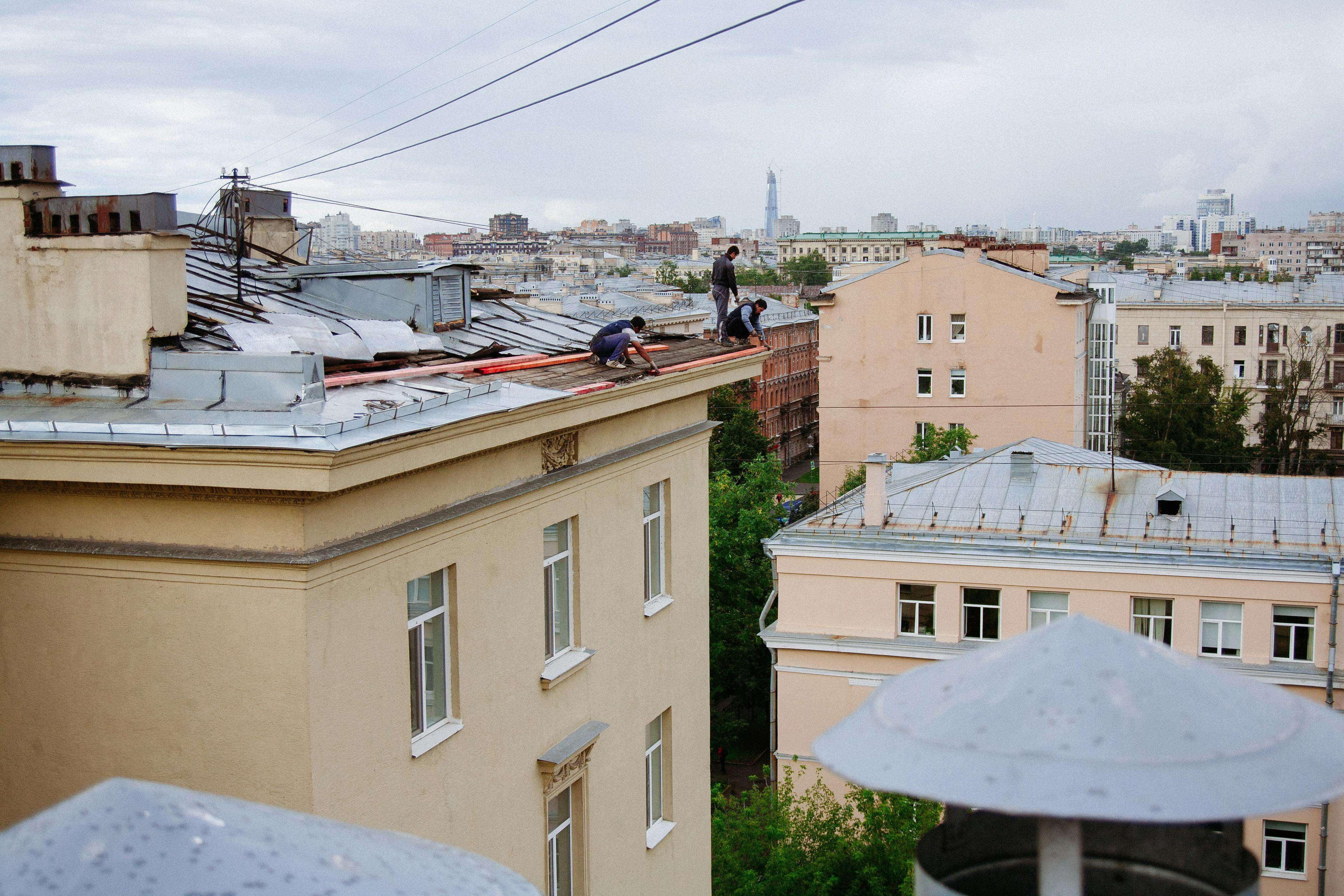
What Is Rope Access Roofing Repair?
A roof develops a problem. Maybe it’s slipped tiles on the top three courses, a section of failed lead flashing, a cracked ridge tile, or a blister on a flat roof membrane near the parapet edge. The repair itself might take an hour or two. But on a building of any significant height, the real problem isn’t fixing the roof — it’s getting to the repair location safely.
Rope access roofing repair means IRATA-certified technicians reach the damaged area using industrial rope access techniques — abseiling from above or ascending from below — to carry out targeted repairs without scaffolding, cherry pickers, or roof access towers. The approach is particularly suited to isolated defects on tall buildings, roof edge repairs, and any situation where the damaged area is small relative to the building height.
This isn’t about replacing rope access for full re-roofing projects. If you need an entire roof stripped and re-covered, you need a traditional roofing contractor with scaffold or edge protection. But for the vast majority of commercial roof repairs — the specific, localised defects that make up most of a maintenance budget — rope access is faster, cheaper, and causes far less disruption than any scaffold-based approach.
When Rope Access Suits Roofing Work
Rope access is the right tool for targeted repairs, not wholesale roof replacement. Here’s where it fits best.
Roof edge repairs on tall buildings. The most common scenario. The perimeter of a pitched roof — the bottom courses of tiles or slates, the verge tiles, the eaves detail — is the area most exposed to wind damage and most difficult to reach from inside the building. On a six-storey residential block or a multi-storey office, scaffold around the full perimeter to replace a handful of tiles costs vastly more than the tiles and labour combined. A rope access team abseils from the ridge or parapet and works along the eaves, replacing tiles, repointing verges, and clearing debris from the gutter line.
Ridge tile and hip tile repairs. Ridge and hip tiles sit at the apex of the roof and are exposed to the worst weather. The bedding mortar (or dry-fix system) deteriorates over time, and loose or missing ridge tiles let water straight into the roof structure. On a tall building, reaching the ridge means either scaffold to the full height plus the roof slope, or an internal access route to the ridge and working from a harness. Rope access technicians can reach the ridge from either direction — over the top from a parapet, or up the slope from the eaves using rope restraint.
Valley gutter repairs. Valley gutters — the internal channels where two roof slopes meet — are a common failure point. They collect debris, their linings deteriorate, and when they leak, the water goes straight into the building below. On multi-storey buildings, valley gutters can be difficult to reach from inside the roof space. Rope access provides direct access from the roof surface.
Lead flashing repairs. Lead flashings at abutments, chimneys, parapet walls, and roof penetrations have a long but finite life. They crack, lift, and detach — particularly code 3 and code 4 lead that’s been subjected to years of thermal cycling. Replacing a section of lead flashing is a skilled but quick job; getting to it on a tall building is the challenge. Rope access solves the access problem without the cost of scaffold.
Flat roof edge repairs. Commercial flat roofs often have problems at the perimeter — where the membrane meets the parapet upstand, or where the roof edge detail meets the facade. These areas are subject to wind uplift, thermal movement, and standing water. Accessing them from the roof surface is sometimes possible, but on buildings without safe roof edge protection, a restraint or rope access system is needed anyway. Full scaffold to repair a 3-metre section of perimeter flashing makes no economic sense.
Chimney repairs on tall buildings. Chimney stacks on Victorian and Edwardian commercial buildings are high, exposed, and often in poor condition. Repointing, reflaunching, replacing pots, and repairing flashings at chimney base level are all standard rope access tasks. The chimney itself usually provides an anchor point, though this needs assessment before loading.
How Rope Access Works for Roofing
Rope access roofing is slightly different from facade work because the technician is working on or near a sloped surface rather than hanging vertically against a wall. The techniques vary depending on the roof type and repair location.
Working from above (descending). On buildings with a flat roof or parapet above the pitched roof area, the team anchors ropes at the parapet and abseils down the roof slope to the repair location. This is the most common approach for roof edge repairs on buildings with accessible flat roof areas above.
Working from below (ascending). On buildings where the roof is the highest point and there’s no higher structure to rig from, technicians may rig from ground level or an intermediate point and ascend to the roof. This is less common for roofing work but sometimes necessary on standalone pitched-roof buildings.
Rope restraint on the roof surface. For work on the roof itself — ridge repairs, valley work, general tile replacement across the slope — technicians may use rope restraint rather than full abseil. They’re on the roof surface, but connected via a harness and rope to an anchor that prevents them sliding or falling off the edge. This combines normal roofing working methods with fall protection.
The materials question. Roofing repairs require materials — tiles, slates, mortar, lead, fixings, sealants. These all need to reach the working position. For small quantities, materials are carried in tool bags or hoisted on ropes. For larger quantities, they’re taken up through the building to roof level or lifted externally using a simple material hoist. A rope access team carrying out a morning’s worth of tile replacements won’t be hauling pallets of tiles up the facade — they’ll take up what they need for each section of work.
Tile and Slate Replacement
Slipped, cracked, and missing tiles or slates are the most common roof defect on UK buildings. The causes are predictable: wind, frost, age, and — on concrete tiles — the gradual breakdown of the nibs that hook the tile onto the batten.
Matching existing tiles. On an older building, matching the existing tile or slate can be a challenge. Manufacturers discontinue profiles, colours change with weathering, and reclaimed materials aren’t always available in the quantity needed. A good roofing contractor will source the closest match possible and may recommend mixing reclaimed and new material to blend the repair.
Fixing methods. Modern practice is to nail and clip every tile, but on older roofs you’ll find tiles that rely purely on their nibs and gravity, with only every fourth or fifth course nailed. When replacing tiles on these roofs, the recommendation is to nail-fix all replacements regardless of the original fixing pattern — it costs virtually nothing extra and dramatically reduces the chance of future wind displacement.
Slate roofs. Slipped slates are re-fixed using a slate hook (a copper or stainless steel strip nailed to the batten beneath), or by removing the surrounding slates, re-nailing, and replacing. On high-quality slate roofs (Welsh slate, Burlington, Westmorland green), it’s worth sourcing proper replacement slates rather than substituting cheaper alternatives that will weather differently.
Flat Roof Repairs
Flat roofs on commercial buildings — felt, single-ply membrane, asphalt, or liquid-applied systems — develop their own set of problems.
Blistering and bubbling. Trapped moisture beneath the membrane heats up in sun and creates blisters. Small blisters are cosmetic; large ones risk splitting and leaking. Repair involves cutting out the blister, drying the substrate, and patching with matching membrane or liquid-applied coating.
Splits and cracks. Thermal movement causes splits in older felt and asphalt roofs, particularly at upstands, kerbs, and where the membrane bridges structural joints. Repair methods depend on the membrane type — felt repairs use torch-applied felt patches, single-ply repairs use hot-air welded patches of matching membrane, and liquid-applied systems can be recoated.
Upstand and flashing failures. The junction between the flat roof surface and vertical upstands (parapets, plant room walls, pipe penetrations) is the most vulnerable area. The membrane turns up the wall and is covered by a flashing — and both can fail. Lead and felt flashings crack and lift; silicone sealants at the top of upstands deteriorate. These are quick repairs individually but need doing promptly to prevent water ingress.
Ponding. Standing water on a flat roof accelerates membrane degradation and adds structural load. It’s usually caused by blocked outlets, inadequate falls, or deflection of the roof deck. Clearing outlets and improving local drainage is a maintenance task; correcting falls across the roof is a more substantial project.
Rope access is relevant to flat roof repairs mainly at the perimeter — the roof edges, parapet junctions, and high-level details that require fall protection to work on safely. For repairs in the middle of a large flat roof, conventional access from inside the building (via a roof hatch or access tower) is usually simpler.
Lead Flashing Repair and Replacement
Lead flashings are ubiquitous on UK commercial buildings, and they require periodic attention.
Why lead flashings fail. Lead expands and contracts with temperature changes — code 4 lead (1.80mm thick) has a coefficient of thermal expansion about twice that of steel. Over years of thermal cycling, the lead fatigues and cracks, particularly at sharp bends and where it’s restrained. Thin lead (code 3, 1.32mm) is more susceptible than heavier codes. Flashings also lift out of chase joints when the mortar pointing deteriorates.
Repair vs replacement. Short cracks in otherwise sound lead can be repaired with lead welding (burning) or patched with self-adhesive lead-faced tape as a temporary measure. But if the lead is generally fatigued — multiple cracks, splits at bends, widespread lifting — replacement is the proper solution. A lead flashing replacement typically involves raking out the old chase, fitting new code 4 or code 5 lead, and repointing the chase with suitable mortar.
Working with lead at height. Lead is heavy — code 4 lead weighs about 20kg per square metre. Rope access technicians carrying out flashing work need to manage the weight of materials at height, which means pre-cutting lead sections to manageable sizes and hoisting them in batches. It’s skilled work, and the technicians who do it regularly are usually experienced leadworkers as well as rope access operatives.
When Scaffold Is Actually Better
Rope access isn’t the answer for every roofing job. Here’s when scaffold makes more sense.
Full re-roofing projects. If the entire roof covering needs stripping and replacing, scaffold with edge protection (or a temporary roof) is the appropriate access method. A full re-roof involves stripping existing tiles or slates, checking and replacing battens and underlay, and re-covering the whole slope. This needs a stable working platform along the full length of the roof, material storage at roof level, and multiple operatives working simultaneously. Rope access can’t replicate that.
Extensive repairs across the full roof slope. If you’ve got defects scattered across the entire roof area — not just at edges or ridges — the cumulative cost of re-rigging rope access at multiple positions may approach the cost of scaffold. The crossover point depends on the building, but as a rough rule: if you need to work at more than about 30% of the roof area, scaffold starts to become competitive.
Low-rise buildings. On buildings of three storeys or fewer, scaffold is relatively cheap and quick to erect. The rope access cost advantage diminishes on shorter buildings because the rigging time is proportionally higher relative to the work time. A two-storey house with slipped tiles is a scaffold or tower scaffold job, not a rope access job.
Structural roof work. If the roof structure itself needs attention — rotten timbers, failed purlins, structural steelwork repairs — this is work that needs to be done from inside the roof space or from a stable platform, not from ropes.
The honest answer is that a good rope access contractor will tell you when scaffold is the better option. If they’re quoting rope access for a full re-roof, question their judgement.
Emergency Leak Response
Roof leaks on commercial buildings are urgent — water coming through the ceiling of an occupied office, shop, or residential flat needs an immediate response. Rope access is well suited to emergency roofing work because of the fast mobilisation time.
Where a scaffold-based response involves ordering scaffold, waiting for it to be delivered and erected, and then gaining access to the roof — a process that can take days — a rope access team can be on site and working within hours.
Emergency roof repairs are usually temporary: a tarpaulin secured over the damaged area, a temporary patch over a split membrane, or missing tiles replaced with the closest available match to weather-tight the roof until a permanent repair can be planned. The permanent repair follows once materials have been sourced and the full scope of damage assessed.
If your building has a reactive maintenance contract with a rope access provider, emergency response times of 4-24 hours are typical.
Planned Roof Maintenance
Reactive roof repairs are more expensive than planned maintenance, for the obvious reason that emergency call-outs cost more and damage escalates between the leak starting and the repair being done.
A planned roof maintenance programme typically includes:
- Annual or biannual roof condition survey by rope access, with photographic reporting. The survey identifies developing defects — cracked tiles, lifting flashings, deteriorating sealants, blocked outlets — before they cause leaks.
- Scheduled repairs based on survey findings, prioritised by urgency. This lets you budget for roof maintenance rather than reacting to emergencies.
- Gutter and outlet clearance carried out alongside roof inspections (see our gutter cleaning service for more detail on this).
- Moss and vegetation removal from roof surfaces, particularly on north-facing slopes where moss growth reduces tile life and blocks water flow.
The survey itself typically costs 500-1,500 depending on building size and complexity. The information it provides — and the early warning of developing problems — is worth many times that in avoided emergency repairs and water damage.
Typical Costs
Roofing repair costs vary widely depending on the defect type, materials, building height, and complexity. Here are some ballpark figures for rope access roofing work.
Tile or slate replacement: 50-100 per tile for the replacement itself (material and labour on the ropes), plus a minimum mobilisation charge of 400-800 for the rope access rigging. Replacing 20 tiles along an eaves line in a single visit might cost 1,500-2,500 total.
Ridge tile repointing or replacement: 40-80 per linear metre. A typical ridge run on a commercial building might be 15-30m, so 600-2,400 plus mobilisation.
Lead flashing replacement: 80-150 per linear metre for supply and fit of code 4 lead by rope access. A 5m flashing at a parapet abutment might cost 500-900 including mobilisation.
Flat roof patch repair: 200-600 per repair depending on size and membrane type, plus mobilisation.
Emergency call-out: Expect a premium of 30-50% over standard rates for same-day or next-day emergency response.
The scaffold comparison: For a localised repair — say, replacing 10 slipped tiles along the eaves of a seven-storey residential block — scaffold erection and hire might cost 4,000-8,000. The rope access approach for the same repair would typically cost 1,200-2,000 all-in. The saving is 60-80% of the access cost.
Working Alongside Roofing Contractors
Not every rope access company employs trained roofers, and not every roofing contractor has rope access capability. Many projects involve the two working together.
The rope access team provides safe access to the repair location and manages all the work-at-height safety: rigging, rescue capability, and harness systems. The roofing contractor provides the trade skills and materials.
If the roofing contractor’s operatives need to work on the ropes, they must hold their own IRATA certification. There’s no way around this — putting an uncertified person on a rope system is illegal and dangerous. Some roofing contractors have staff with dual qualifications (roofing trade + IRATA), which simplifies coordination.
The alternative model is a rope access company with in-house roofing capability. These firms employ technicians who are both IRATA-certified and experienced roofers. For straightforward repairs — tile replacement, flashing work, minor flat roof patches — this is the simplest arrangement and usually the most cost-effective.
When getting quotes, clarify what’s included. A “rope access roofing repair” quote should cover both the access and the roofing work. If you’re getting separate quotes for access and roofing, make sure the two contractors have worked together before and have agreed their coordination arrangements.
Health and Safety
Roofing work at height is statistically one of the most dangerous activities in the construction industry. Falls from roofs account for a significant proportion of workplace fatalities in the UK each year. Proper safety management is not optional. When engaging a rope access contractor for roofing work, expect:
- IRATA certification for all technicians working at height. Three levels of qualification, mandatory three-yearly re-certification, and logged experience requirements.
- A site-specific risk assessment and method statement covering anchor selection, rope protection against sharp roof edges (tiles, ridge tiles, and metal flashings can cut through ropes), exclusion zones below, fragile roof surfaces (rooflights, asbestos cement sheets), and rescue procedures.
- Edge protection or warning lines where technicians are working on the roof surface near unprotected edges, supplementing the rope system.
- Fragile surface identification. Many commercial roofs include fragile elements — plastic rooflights, fibre cement sheets, corroded metal decking — that won’t support a person’s weight. These must be identified before work starts and either avoided or protected.
- Appropriate insurance. Employers’ liability and public liability, with cover levels appropriate for the work. Most commercial clients expect a minimum of 5 million public liability.
- Weather monitoring. Roof work is more weather-sensitive than facade work — wind speeds that are manageable on a vertical face become dangerous on an exposed roof slope. Good contractors set clear wind-speed limits and will stand down rather than work in unsafe conditions.
Get a Quote
If your building needs roof repairs, a condition survey, or you want to set up a planned maintenance programme, we can connect you with experienced rope access roofing contractors in your area. All operators in our directory are IRATA-certified, fully insured, and experienced in commercial roof work at height. Submit a quote request with your building details and the nature of the problem, and we’ll match you with suitable contractors who can provide competitive pricing.