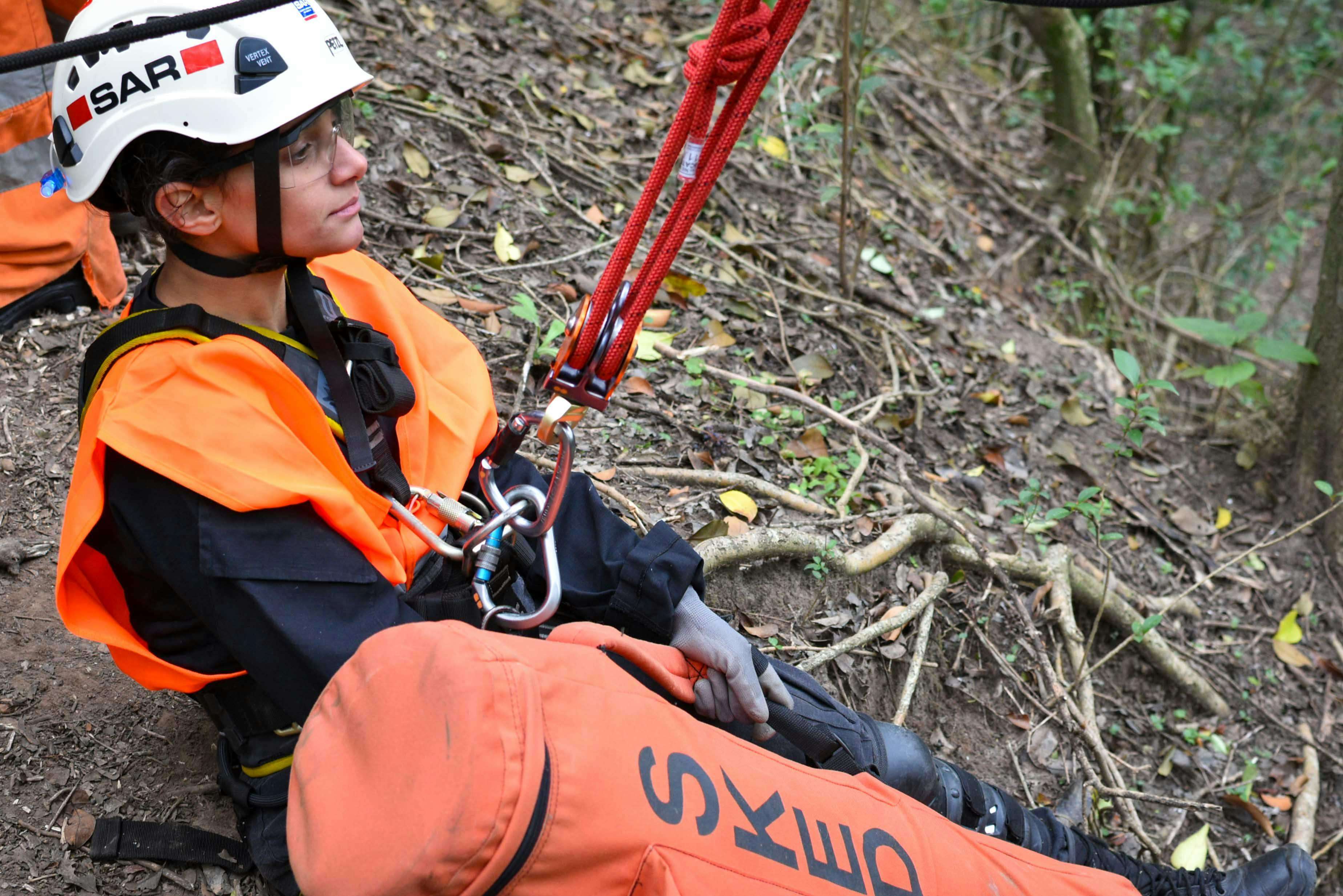
What Is Rope Access Training?
Rope access training provides the qualifications needed to work as an industrial rope access technician. The industry standard in the UK (and globally) is the IRATA (Industrial Rope Access Trade Association) certification scheme, which operates across three levels. Each level involves practical skills training followed by an independent assessment, and the qualifications are recognised worldwide.
This isn’t climbing or abseiling for adventure. Industrial rope access is a highly regulated discipline with its own code of practice, equipment standards, and safety management system. The training reflects that — it’s thorough, physically demanding, and technically detailed. The pass rate is around 80%, which means roughly one in five candidates doesn’t make it through the assessment first time. It’s a genuine qualification that means something in the industry.
We connect people with IRATA-approved training centres across the UK. Whether you’re an individual looking to enter the industry, or a company needing to train or upskill your workforce, we can help you find the right course at a provider with a strong reputation and good pass rates.
IRATA Level 1 — Rope Access Technician
Level 1 is where everyone starts. It’s the entry-level qualification that allows you to work on a rope access site under the supervision of a Level 3 (supervisor/safety supervisor).
What It Covers
The Level 1 course teaches the core rope access skills:
- Equipment selection, inspection, and care — harnesses, helmets, descenders, ascenders, connectors, ropes, and slings
- Rigging fundamentals — setting up anchor points, deviation lines, and re-anchors
- Ascending and descending on fixed ropes
- Changeovers between ascending and descending mid-rope
- Passing intermediate anchors (re-belays and deviations) on the way up and down
- Basic rope-to-rope transfers
- Aid climbing techniques
- Casualty rescue — extracting a suspended colleague using standard rescue procedures
- Knots, hitches, and their applications
- Understanding the IRATA code of practice and safe working procedures
Duration and Format
A Level 1 course typically runs for 4–5 days of training followed by a 1-day assessment. The assessment is conducted by an independent IRATA assessor (not the training instructor), which ensures consistent standards across all training centres.
The training days are physically intensive. You’ll spend most of the time on ropes in the training centre, practising manoeuvres repeatedly until they become fluid. Most centres start at 08:00 and finish around 17:00, and you’ll feel it in muscles you didn’t know you had.
Prerequisites
There are no formal prerequisites for Level 1 other than being at least 18 years old. You don’t need any prior climbing or rope experience. You do need to be reasonably fit — you’ll be hauling yourself up ropes, carrying rescue loads, and working in a harness for hours at a time. Most training centres don’t require a medical certificate for Level 1, but some operators and clients will want one before you start work on site.
The Assessment
The Level 1 assessment is a practical exam lasting a full day. The assessor will ask you to demonstrate every core skill — ascending, descending, changeovers, passing re-belays, deviations, and a full rescue sequence. You’ll also sit a multiple-choice written paper covering IRATA procedures, equipment knowledge, and safety management.
The pass rate for Level 1 is typically around 80%. The most common reasons for failure are:
- Not completing the rescue within the time limit (the assessor watches for smooth, confident execution)
- Equipment handling errors (misclipping, not locking connectors properly)
- Written paper (candidates who haven’t reviewed the IRATA code of practice sometimes struggle with the theory questions)
If you fail, you can re-sit the assessment within 60 days at the same or a different training centre.
Cost
Level 1 IRATA training costs between £850 and £1,400 depending on the training centre, location, and whether equipment is included. London and the South East tend to be at the higher end; centres in the Midlands, North, and Scotland are often more competitive. Some centres include PPE (harness, helmet, etc.) in the price; others charge extra or require you to bring your own.
IRATA Level 2 — Experienced Technician
Level 2 is for technicians who have been working at Level 1 and want to take on more responsibility. It’s not an automatic progression — you need to earn it.
Prerequisites
To register for Level 2 training, you need:
- A current IRATA Level 1 certification
- A minimum of 12 months since your Level 1 assessment
- At least 1,000 logged hours of rope access work in your IRATA logbook
Those 1,000 hours must be genuine, verified rope access work hours. Your logbook entries should be signed by the Level 3 supervisor on each job. IRATA takes the logbook seriously — if your hours don’t stack up at assessment, you won’t pass.
What It Covers
Level 2 builds on Level 1 with more advanced rigging and rescue skills:
- Complex rigging scenarios — multi-point anchors, tensioned rope traverses, horizontal and inclined hauling systems
- Advanced rescue techniques — rescue from various positions and configurations, including from structures and confined spaces
- Rigging for others — setting up rope access systems for a team, not just yourself
- Risk assessment and method statement input
- Team leadership skills (you may be asked to lead small work teams, though you can’t supervise a site — that’s Level 3)
Duration and Cost
Level 2 training is typically 4–5 days of training plus 1 day assessment. Costs range from £900 to £1,500.
The step up from Level 1 to Level 2 is significant. You’re expected to be fast, confident, and smooth on the ropes — the basic skills should be second nature so you can focus on the more complex rigging and rescue scenarios. Candidates who come in with strong site experience find the transition manageable; those who’ve done their minimum 1,000 hours on less technical jobs sometimes find Level 2 more challenging than expected.
IRATA Level 3 — Rope Access Supervisor
Level 3 is the top tier. Level 3 technicians are qualified to supervise rope access operations, write method statements, carry out risk assessments, and take overall responsibility for the safety of a rope access work site.
Prerequisites
- Current IRATA Level 2 certification
- A minimum of 12 months since your Level 2 assessment
- At least 1,000 additional logged hours at Level 2 (2,000+ total career hours)
What It Covers
Level 3 training focuses on supervisory and management skills:
- Site-specific planning — writing rope access plans, method statements, and risk assessments
- Supervising rope access teams, including multi-team operations
- Equipment management and inspection regimes
- Incident investigation and reporting
- Advanced rescue planning for complex scenarios
- Client liaison, permit-to-work systems, and site management integration
- Thorough knowledge of the IRATA code of practice and relevant legislation (LOLER, PUWER, Working at Height Regulations)
Duration and Cost
Level 3 training runs for 5 days of training plus 1 day assessment, and costs £1,000 to £1,800. The written paper at Level 3 is substantially more demanding than Levels 1 and 2, covering regulatory knowledge, planning, and scenario-based questions.
A Level 3 certification is a career milestone. Level 3 technicians command higher day rates (typically £250–£400+ per day) and are essential on every rope access job — IRATA requires at least one Level 3 on every site. Good Level 3 supervisors are always in demand.
Revalidation — Keeping Your Ticket Current
IRATA certifications are valid for 3 years. Before your certification expires, you must complete a revalidation assessment at an IRATA-approved training centre. This isn’t a full course — it’s a 1–2 day refresher and assessment to confirm you’re still competent at your current level.
The revalidation window opens 6 months before your expiry date. If you let your certification lapse, you’ll need to take the full training course again, so keeping track of your expiry date matters.
Revalidation costs are lower than initial training — typically £400–£700 depending on your level and the training centre.
One important detail: you must have logged rope access hours during your certification period to revalidate. If you qualified at Level 1 three years ago but haven’t done any rope access work since, an assessor is going to have questions. The minimum expectation isn’t formally defined in hours, but you should have a reasonably active logbook showing you’ve been working on ropes.
GWO Training Modules
If you’re planning to work in the wind industry (and a lot of rope access work is in wind these days), you’ll need GWO (Global Wind Organisation) training in addition to your IRATA qualification.
GWO is a non-profit founded by wind turbine manufacturers and owners to create standardised safety training across the industry. Their training modules are accepted at wind farms worldwide and are a mandatory site access requirement for virtually all UK wind operators.
Basic Safety Training (BST)
The core GWO package, consisting of five modules:
- Working at Height — using harnesses, fall arrest systems, and rescue from height (2 days)
- First Aid — emergency response and casualty management (2 days)
- Manual Handling — safe lifting and carrying techniques relevant to wind turbine work (1 day)
- Fire Awareness — fire prevention, fighting, and evacuation in turbine environments (1 day)
- Sea Survival — for offshore work only; helicopter underwater escape training (HUET) and sea survival (1 day, usually offshore only)
BST costs around £1,200–£1,800 for the full set of modules. Individual modules can be taken separately, and refreshers (required every 2 years) are shorter and cheaper.
Advanced Rescue Training (ART)
Covers rescue scenarios specific to wind turbine environments — hub rescue, nacelle evacuation, and tower rescue. Required for anyone who may need to carry out rescue operations on a wind turbine. Typically 2–3 days, costing £500–£800.
Blade Repair Training (BTR)
The specialist module for technicians carrying out composite blade inspection and repair. Covers damage assessment, materials handling, surface preparation, laminate layup, and quality control. Typically 5 days, costing £1,500–£2,500.
Enhanced First Aid (EFA)
An extended first aid course for offshore personnel who may need to manage casualties for extended periods before professional medical help arrives. Usually 3 days, costing £400–£600.
Confined Space and Rescue Training
Many rope access jobs involve confined space entry — working inside tanks, vessels, tunnels, shafts, and other enclosed spaces where atmospheric hazards, restricted access, and limited ventilation create additional risks.
Confined space training covers:
- Hazard identification and atmospheric monitoring (gas detection)
- Entry and exit procedures
- Use of breathing apparatus (BA) and escape sets
- Confined space rescue techniques
- Legal requirements under the Confined Spaces Regulations 1997
A typical confined space course runs 2–3 days and costs £350–£600. For rope access technicians who will carry out confined space rescue, a combined course covering both entry and rescue is recommended — usually 3–4 days at £500–£900.
Having confined space qualifications alongside IRATA opens up a broader range of work — industrial shutdown maintenance, tank cleaning, and work inside wind turbine towers and nacelles all benefit from confined space competence.
Combined Courses and Trade Skills
Some training centres offer combined courses that package IRATA training with complementary trade skills:
- IRATA + CSCS card — for construction site access
- IRATA + PASMA — mobile tower scaffold competence
- IRATA + IPAF — powered access (cherry picker) operation
- IRATA + painting/blasting — industrial coating application qualifications
- IRATA + NVQ in rope access — for those wanting a formal vocational qualification
These combined packages can save time and money compared to booking courses separately, and they make you more employable. An IRATA Level 1 tech who can also paint, inspect coatings, or operate a cherry picker is more useful on a mixed-access job than one who can only do rope work.
Fitness Requirements
There’s no formal IRATA fitness test, but rope access is physically demanding work. During training, you’ll be:
- Ascending ropes using mechanical ascenders (imagine climbing a vertical rope for 10–30 metres repeatedly)
- Carrying rescue loads (hauling a person-sized weight up or across ropes)
- Working in a harness for 6–8 hours per day (this is uncomfortable at first — harness tolerance improves with time)
- Moving through complex rigging setups that require upper body strength, core stability, and flexibility
You don’t need to be an athlete. Plenty of successful rope access technicians are regular people who are reasonably fit and healthy. But if you struggle with upper body strength, have chronic back or knee problems, or have a fear of heights that you haven’t resolved, the training will be tough.
Some training centres offer a one-day taster session or fitness assessment before committing to the full course. If you’re unsure whether you’re ready, this is a sensible step.
For work on operational sites, many clients require an occupational health medical certificate. In the wind industry, the GWO medical standard applies. Offshore work requires an OGUK/OPITO medical. Your training centre can advise on which medicals you’ll need for your target industry.
What to Expect During Training
A typical IRATA Level 1 training week looks something like this:
Day 1: Equipment familiarisation, harness fitting, knots and hitches, basic ascending and descending. You’ll start on low-level rigs and build up. By the end of the day, you’ll be ascending and descending confidently on a single rope.
Day 2: Changeovers (switching between ascent and descent mid-rope), passing re-belays and deviations. This is where the technical skill starts to develop — you need to manage multiple pieces of equipment simultaneously while maintaining safety at all times.
Day 3: Aid climbing, rope-to-rope transfers, and more complex manoeuvres. The pace picks up as the instructor begins to simulate real work scenarios.
Day 4: Rescue — the critical skill. You’ll learn to reach a casualty, attach to them, disconnect them from their system, and lower them to the ground. The rescue sequence is the most assessed skill at every IRATA level.
Day 5 (if applicable): Revision, practice under assessment conditions, and any remaining skills. The instructor will give honest feedback on where you’re strong and where you need to focus before the assessment.
Assessment day: The independent assessor arrives. You’ll demonstrate every skill, one at a time, under observation. The atmosphere is focused but fair — assessors want you to pass, but they won’t compromise on standards.
Career Paths After Qualification
A fresh IRATA Level 1 opens the door to a range of industries:
- Wind energy — onshore and offshore turbine maintenance (add GWO for this)
- Construction — facade installation, structural inspection, high-level cleaning
- Oil and gas — platform maintenance, flare tip inspection, riser and pipeline work
- Telecoms — mast and tower installation and maintenance
- Utilities — power station maintenance, chimney inspection, cooling tower work
- Events and entertainment — rigging in venues and stadiums
- Conservation — building and monument restoration, cliff face work
The wind industry is currently the largest single employer of rope access technicians in the UK, and demand continues to grow as the installed fleet expands. Offshore wind in particular offers high day rates and consistent work for technicians with the right certification stack.
Earning Potential
Day rates for rope access technicians in the UK vary by level, industry, and location:
- IRATA Level 1: £150–£250 per day (onshore), £250–£350 per day (offshore)
- IRATA Level 2: £200–£300 per day (onshore), £300–£450 per day (offshore)
- IRATA Level 3: £250–£400 per day (onshore), £400–£600 per day (offshore)
These are typical contractor/freelance rates. Employed technicians may earn less per day but get holiday pay, pension, and sick pay. The trade-off between employment and self-employment is a personal decision that depends on your risk tolerance and how much admin you’re willing to do.
With a full offshore ticket (IRATA + GWO + BOSIET + trade skills), technicians can realistically earn £40,000–£70,000 per year. High-demand periods and specialist skills (blade repair, NDT inspection, welding) push this higher.
Choosing a Training Provider
Not all training centres are equal. Here’s what to look for:
IRATA approval — this is non-negotiable. Only IRATA-approved training centres can deliver IRATA-assessed courses. Check the IRATA website for the current list of approved centres. If a centre isn’t on the list, walk away.
Pass rates — most reputable centres have pass rates of 75–85%. Significantly higher than this might suggest the centre isn’t challenging enough; significantly lower might suggest poor instruction. Ask the centre for their recent pass rate data.
Instructor experience — the best instructors are working technicians who teach part-time, not full-time classroom trainers who haven’t been on a rope in years. Ask about your instructor’s background.
Facilities — a good training centre has a variety of rigging setups that simulate real-world scenarios, not just a single wall with a few bolts in it. External training rigs, confined space simulators, and high-level structures all make for better training.
Class sizes — smaller groups mean more individual attention. Look for centres that limit class sizes to 4–8 trainees per instructor.
Location — IRATA-approved training centres are spread across the UK. Major hubs include Aberdeen, Newcastle, Liverpool, Bristol, London, and various sites in the Midlands. If you’re planning to work in the wind industry, training near a wind energy hub (Aberdeen, Grimsby, Hull, Lowestoft) can be useful for making industry contacts.
Post-training support — some centres help with job placement, CV writing, or connecting graduates with employers. This can be valuable, especially for Level 1 candidates entering the industry for the first time.
The UK Rope Access Job Market
The UK rope access market has grown steadily over the past decade, driven primarily by the wind energy sector. As of the mid-2020s, the market is characterised by:
- Strong demand for qualified technicians, particularly those with GWO and offshore certifications
- A shortage of IRATA Level 3 supervisors — there are more jobs than qualified supervisors, which drives up Level 3 rates
- Seasonal patterns — spring and summer are busiest for external maintenance work, with some quieter periods in winter (though offshore work continues year-round)
- Growing international demand — UK IRATA qualifications are recognised globally, and technicians regularly work in Europe, the Middle East, Asia, and Australia
The industry isn’t immune to economic cycles — a downturn in oil and gas or a slowdown in wind farm construction will affect demand. But the structural trend is upward, driven by the UK’s commitment to offshore wind expansion and the ongoing maintenance needs of the existing fleet.
Find a Training Provider
We work with IRATA-approved training centres across the UK. Whether you’re looking for your first Level 1 course, upgrading to Level 2 or 3, revalidating your certification, or adding GWO and confined space qualifications, we can point you to providers with strong track records and good facilities.
Tell us what you’re looking for — which level, any additional modules, your preferred region — and we’ll connect you with training centres that fit.