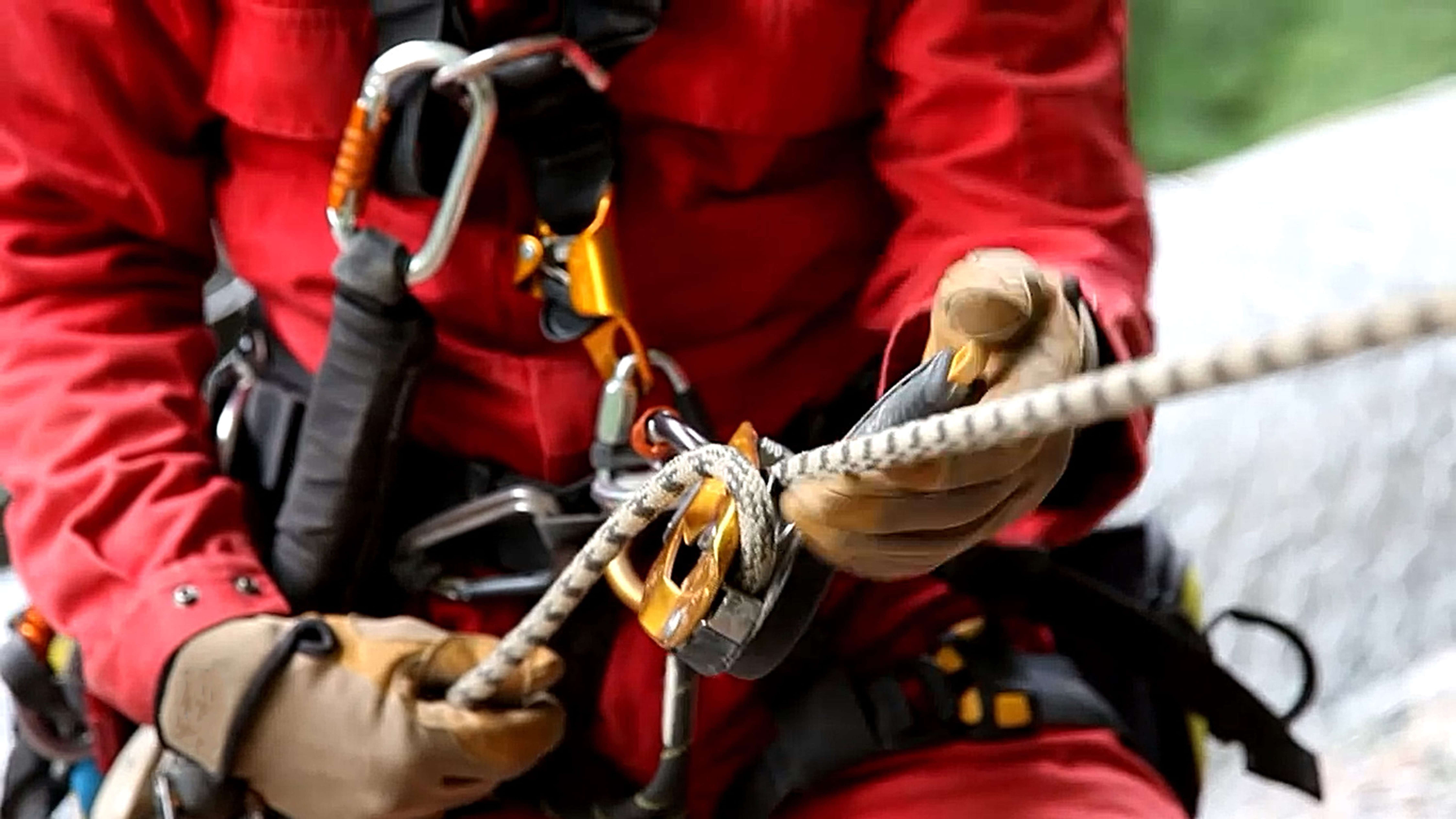
What Are Safety Systems?
Safety systems — also called fall protection systems or fall arrest systems — are permanently installed anchor points, cables, and rails that allow people to work safely at height on a building. They are the invisible infrastructure that makes roof maintenance, facade cleaning, gutter work, and equipment servicing possible without erecting scaffolding every time.
The main types include:
- Single-point anchors (eyebolts) — individual anchor points fixed to the roof or structure, to which a worker clips their harness lanyard. Installed to BS 7883.
- Horizontal lifeline systems — stainless steel cable systems spanning between end anchors, allowing a worker to traverse a roof edge or walkway while remaining clipped on. Often called mansafe systems (after the original brand name that became generic).
- Vertical lifeline systems — cable or rail systems on ladders or vertical structures, providing fall arrest during climbing.
- Rail systems — rigid overhead or parapet-mounted rails that a trolley runs along, offering similar traverse protection to cable systems but with less deflection.
- Davit bases — socket fixtures installed at roof edges or parapets to accept removable davit arms for suspended access (e.g. cradle systems for window cleaning).
There is a certain elegance in using rope access to install these systems. Rope access technicians use their own portable safety equipment to reach the installation locations, then fix permanent safety systems that future maintenance teams will rely on for years to come.
Why Buildings Need Fall Protection Systems
The legal framework is clear. The Work at Height Regulations 2005 require that any work at height is properly planned and that appropriate equipment is used. Where people regularly need to access a roof or elevated area for maintenance, the regulations expect a safe system of work — and permanent fall protection is almost always the most practical solution.
CDM 2015 (Construction Design and Management Regulations) places a specific duty on designers to consider how a building will be maintained throughout its life. A well-designed building should have fall protection systems specified from the outset, so that every future maintenance task — from cleaning gutters to servicing plant equipment — can be carried out safely.
In practice, many existing buildings were designed before these requirements were as well-established as they are today. Retrofitting fall protection systems to buildings that lack them is one of the most common reasons facilities managers call on rope access teams.
Beyond legal compliance, the practical benefits are significant:
- Reduced ongoing costs — once a lifeline system is installed, future maintenance contractors can clip on and work safely without needing expensive temporary access equipment.
- Faster maintenance response — a leaking roof or failed extract fan can be attended to immediately by someone who clips onto the existing system, rather than waiting days or weeks for scaffolding.
- Duty of care — if a contractor or employee falls from your building because adequate fall protection was not provided, the building owner or manager faces serious legal consequences.
Types of System and Where They Are Used
Rooftop eyebolts are the most common starting point. A grid of eyebolts across a flat roof allows maintenance workers to move between anchor points while always remaining connected. They are typically installed on concrete upstands, steel beams, or through-fixed to the roof structure. Spacing depends on the lanyard length being used — usually no more than 2.4 metres between anchors for a standard 2-metre lanyard.
Horizontal lifeline (mansafe) systems are used where workers need to traverse along a roof edge, parapet, or walkway. A tensioned stainless steel cable runs between end posts, with intermediate brackets maintaining the cable height. The worker clips a shuttle device onto the cable and walks along, protected from a fall the entire length. These are commonly installed along roof edges adjacent to plant equipment, around roof perimeters, and along walkways to roof access points.
Vertical lifeline systems are fitted to fixed ladders on the outside of buildings, inside lift shafts, on chimney stacks, and on telecom masts. A cable or rigid rail runs the height of the ladder, and the climber attaches a fall arrest device that travels freely during the climb but locks instantly in a fall.
Rail systems offer the same protection as cable lifelines but use a rigid aluminium or steel track. They produce less deflection in a fall (which matters when working near roof edges where swing distance is critical) and can handle more users simultaneously. The trade-off is higher installation cost.
Davit bases are sockets set into parapets or roof edges to accept removable davit arms. These arms support cradles or bosun’s chairs for suspended access — typically window cleaning. The bases remain flush with the surface when not in use, and the davits are only installed when access is needed.
New Build vs Retrofit
On a new build, fall protection should be designed in from the start. The structural engineer specifies fixing points that tie into the primary structure, cable routes are planned around the maintenance access strategy, and everything is installed before the building is handed over. This is the cleanest and cheapest approach.
Retrofit is more challenging but equally important. The rope access team needs to assess the existing structure to confirm it can accept the loads imposed by fall protection anchors. A single eyebolt in a fall arrest situation can see loads of 6kN or more — that load has to go somewhere, and the fixing must be appropriate for the substrate.
Common retrofit scenarios include:
- Concrete roofs — expansion anchors or resin-bonded fixings into the structural slab.
- Steel frame buildings — bolted connections to structural steelwork, often requiring access to the underside of the roof deck.
- Timber structures — through-bolted connections with load-spreading plates.
- Stone and masonry parapets — resin anchors with pull-out testing to confirm capacity.
Every anchor is proof-loaded after installation and individually certified. There is no guesswork involved — each fixing is tested to confirm it meets the design load before it is signed off.
Inspection and Recertification
Fall protection systems are safety-critical equipment. They must be inspected and recertified at regular intervals — typically annually — to confirm they remain fit for purpose.
BS 7883 covers the inspection of anchor devices and eyebolts. BS EN 795 covers anchor devices for personal fall protection equipment more broadly. Both standards set out what needs to be checked, how, and how results should be recorded.
An annual inspection typically covers:
- Visual check of all anchors, cables, brackets, and connections for signs of corrosion, damage, or loosening.
- Functional test of cable tension, shuttle devices, and fall arrest mechanisms.
- Pull testing of a sample of anchors to confirm they still meet the required load capacity.
- Documentation review — checking that all system components match the original installation records and that no unauthorised modifications have been made.
Each inspection results in a certificate of conformity (or a deficiency report if problems are found). This certificate is your evidence of compliance — keep it on file, because an HSE inspector will ask for it.
Rope access is the obvious choice for annual inspections. The whole point of these systems is that they are on roofs, facades, and other elevated locations. Erecting scaffolding to inspect the very systems that are supposed to eliminate the need for scaffolding is a contradiction that nobody’s budget can sustain.
A typical annual inspection of a rooftop eyebolt and lifeline system by a rope access team costs £500-£1,500, depending on the number of anchors and system complexity. The same inspection requiring a cherry picker or scaffolding could easily cost three to five times that amount.
Working with Designers and Specifiers
Fall protection system design is a specialist discipline. The designer needs to understand:
- The maintenance activities the system must support (what tasks, how often, how many people simultaneously)
- The building geometry and structure (where loads can be transferred, what substrates are available)
- The relevant standards (BS 7883, BS EN 795, BS EN 353 for guided-type fall arresters, BS 8610 for davit systems)
- User requirements (ease of use matters — a system that is awkward to use will be circumvented)
As a facilities manager or building owner, you should work with a specialist fall protection designer or one of the major system manufacturers (Latchways, Sayfa, XSPlatforms, and others all offer design services). The design package then goes to the rope access installation team, who fit the system exactly as specified.
Some rope access companies have in-house design capability and can handle the entire process from survey through design, installation, and certification. This is often the most efficient route for retrofit projects where an initial survey is needed to establish what is structurally possible.
Typical Costs
Fall protection system costs depend heavily on the type, extent, and complexity of the installation. Here are some indicative figures:
Individual eyebolts (installed, tested, certified):
- Supply and install: £80-£150 per anchor
- A typical flat roof might need 20-40 anchors: £1,600-£6,000
Horizontal lifeline system (mansafe cable):
- Supply and install: £120-£200 per linear metre
- A 50-metre roof edge run: £6,000-£10,000
Vertical lifeline on a fixed ladder:
- Supply and install: £150-£250 per linear metre
- 15-metre chimney ladder: £2,250-£3,750
Davit bases:
- Supply and install: £500-£800 per base
- Typical window cleaning scheme (8-12 bases): £4,000-£9,600
Annual inspection and recertification:
- Small to medium system (up to 30 anchors): £500-£1,000
- Large system (50+ anchors, multiple lifelines): £1,000-£2,500
These figures include the rope access element. If the same work were done from scaffolding, you would add the scaffold cost on top — which for a multi-storey building typically exceeds the cost of the safety system itself.
Health and Safety Expectations
Fall protection installation is inherently safety-focused work, and you should expect a correspondingly high standard of documentation and process:
- Method statement and risk assessment — specific to your building and the proposed system, not a generic template.
- IRATA certification — all rope access technicians must hold current certification at the appropriate level. Level 3 technicians supervise the work.
- Installer competence — technicians should be trained and certified by the system manufacturer for the specific products being installed.
- Proof load testing — every anchor tested after installation, with recorded results.
- Installation certificate — a formal document listing every component installed, its location, the test results, and confirming compliance with the relevant standards.
- O&M manual — an operations and maintenance manual for the completed system, including inspection schedules and user instructions.
- Insurance — public liability and professional indemnity insurance covering the installation work.
Get a Quote
Whether you need a full fall protection system designed and installed, an existing system inspected and recertified, or just some advice on what your building needs, our directory connects you with experienced rope access contractors who do this work day in, day out. Tell us about your building and requirements, and we will match you with vetted, IRATA-certified teams who can survey, quote, and deliver. No obligation, no delay — just qualified people who know what they are doing.