What Is Rope Access Sign Installation?
Every time a business rebrands, a new tenant moves in, or a building changes hands, there’s signage that needs to go up — and usually signage that needs to come down first. On a single-storey retail unit, that’s a ladder job. On anything above three or four storeys, you’re into access equipment territory: scaffolding, cherry pickers, or rope access.
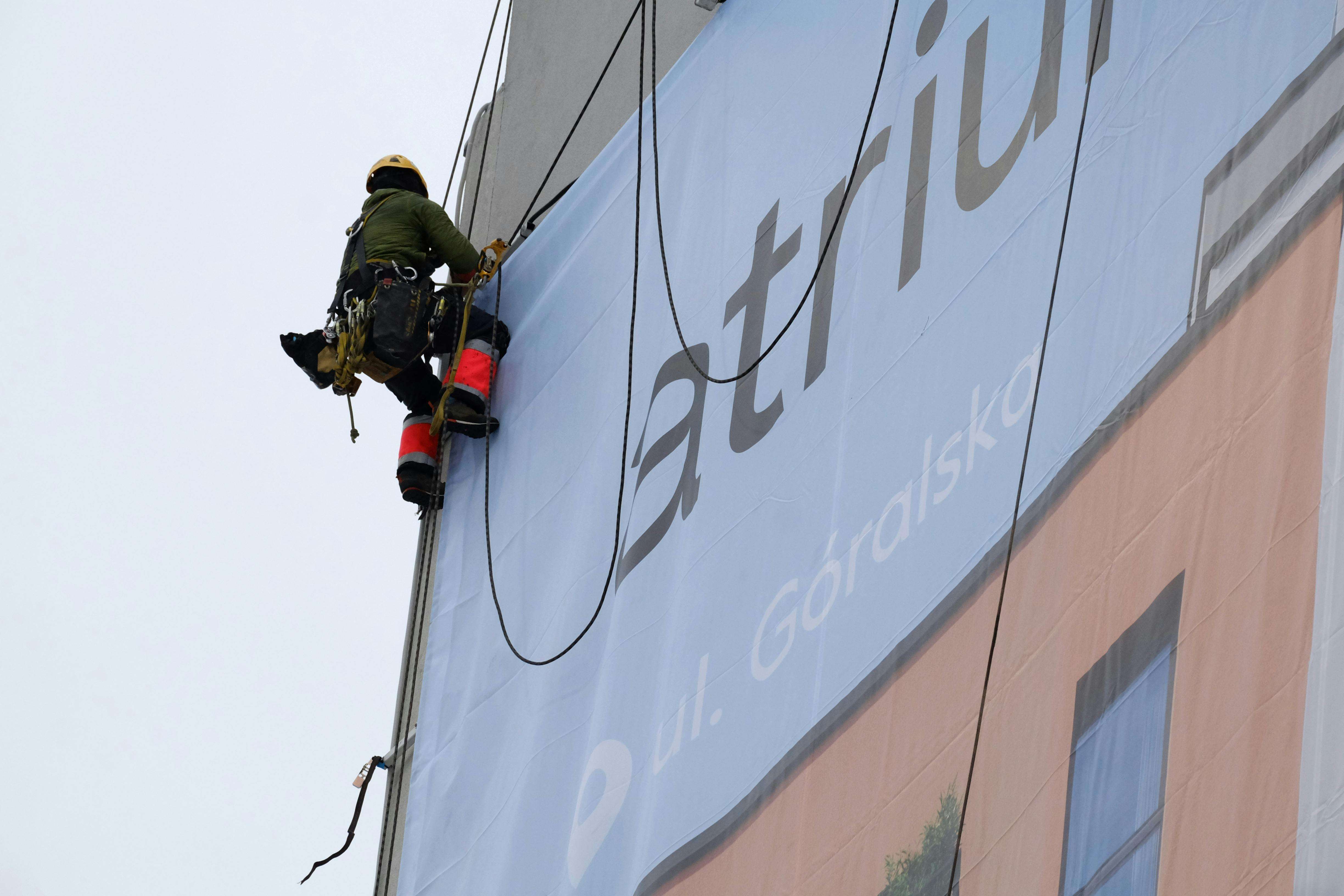
Rope access sign installation means IRATA-certified technicians abseil to the sign location, remove the old signage (if applicable), prepare the fixing points, and install the new sign — all without scaffold or MEWPs. The same approach works for banners, flags, vinyl graphics, and illuminated signage, including the electrical connections.
For a straightforward sign swap on a mid-rise building, scaffold might take three days to erect, half a day for the actual sign work, and another two days to dismantle. A rope access team can do the whole job in a day. The cost difference is significant, and the disruption difference is even more so — no scaffold blocking the pavement, no temporary traffic management, no weeks of visual clutter on the building facade.
When Rope Access Makes Sense for Signage
Not every sign job needs rope access, and not every sign job suits it. Here’s where it fits.
High-street retail and commercial premises. Shops, restaurants, and offices on busy streets need signs changed with minimum disruption to trade and pedestrian flow. Scaffold on a high street means pavement closures, temporary barriers, and potentially lost custom. Rope access needs no ground space — the team works from the roof down, and pedestrians walk underneath without being diverted.
Corporate rebranding and multi-site rollouts. When a company rebrands or a franchise changes hands, the signage needs updating across multiple locations, often to a tight deadline. Rope access is faster per site than any scaffold-based approach, which makes it the practical choice when you’re doing twenty buildings in a month rather than one.
Shopping centres and retail parks. Large fascia signs on anchor stores, directional signage at height, and internal atrium signage all lend themselves to rope access. Shopping centre management teams generally prefer it because the work happens quickly and doesn’t require closing off large areas of the car park or pedestrian walkways for scaffold or MEWPs.
Office buildings and commercial towers. Corporate lettering, logo panels, and illuminated signs at upper levels are bread-and-butter rope access work. Many modern office buildings were designed with rope access in mind — davit bases on the roof make rigging straightforward.
Temporary and event signage. Banners, flags, and promotional signage for events, product launches, or seasonal campaigns need to go up fast and come down fast. Rope access is ideal — a team can hang a building-height banner in a morning and strike it the same day the event ends.
Industrial and warehouse buildings. Large format signage on industrial units, distribution centres, and factory buildings is often high up on flat, featureless facades. Cherry pickers can usually reach, but ground conditions (uneven yards, soft verges, drainage runs) often restrict where they can set up. Rope access has no such limitations.
Where Scaffold Might Be Better
If you’re installing signage across the full width of a building at a consistent low height — say a continuous fascia sign at first-floor level on a long retail frontage — scaffold may actually be the more efficient option. The scaffold provides a continuous working platform, which is faster for long horizontal runs than repositioning rope access points. The crossover point is usually around second or third floor height; above that, rope access wins on cost and speed.
Types of Signage Work
Illuminated Signs
Illuminated signage — LED-backlit lettering, lightbox fascias, halo-lit channel letters — is the most common type of commercial sign installation at height. The work involves mounting the sign or individual letters, running electrical cabling, and connecting to an isolator or fused spur inside the building.
Rope access technicians who specialise in signage are comfortable with both the access and the electrical work. Many hold 18th Edition wiring qualifications alongside their IRATA certification. For larger or more complex electrical installations, the rope access team provides the access while a qualified electrician works alongside them — either on the ropes (if they hold IRATA certification) or from a position the rope access team has made accessible.
Existing electrical supplies from a previous sign can usually be reused, which simplifies things. If new cabling is needed, the route from the sign position to the nearest supply point needs planning before the work starts — chasing cable routes through cladding or masonry at height is possible but slower than running cable through pre-planned conduit.
Non-Illuminated Signs
Flat-cut lettering, dibond panels, PVC fascia boards, and projecting blade signs. Simpler to install than illuminated signs (no electrical work), but the fixing method matters. The substrate — brick, stone, render, cladding panel, concrete — determines the fixing type and approach. A good sign installer will know what fixings to use for each substrate and carry the right kit.
Vinyl and Graphics Application
Large-format vinyl wraps and printed graphics on building facades are increasingly popular for both permanent branding and temporary campaigns. Applying vinyl at height is skilled work — the material needs to be positioned accurately, applied without air bubbles, and trimmed cleanly. Wind is the enemy: vinyl application at height on a breezy day is difficult, so these jobs are weather-dependent.
Rope access technicians who do this regularly have techniques for handling large sheets of vinyl on the ropes — working in pairs, using temporary tack positions, and choosing low-wind weather windows.
Banners and Flags
Banner hanging is one of the simplest rope access signage tasks. The fixings (eyebolts, banner arms, or wire rope) are installed first, then the banner is rigged in place. For building-height banners — the kind you see on development hoarding or event venues — the rope access team unfurls the banner from the top while a ground crew manages the bottom edge.
Flag poles and flags on building facades are similar — the pole bracket is fixed to the building, the pole is mounted, and the flag is attached. Rope access makes flag changes quick and inexpensive, which matters when you’re swapping flags regularly for different events or seasons.
Planning Permission
Signage on commercial buildings in England and Wales is controlled by the Town and Country Planning (Control of Advertisements) (England) Regulations 2007 (and the equivalent Welsh regulations). The rules are specific, and getting them wrong means enforcement notices and removal at your expense.
Deemed consent covers many standard business signs — a non-illuminated fascia sign on business premises, for example, generally has deemed consent provided it meets size limits. Illuminated signs almost always need advertisement consent (a specific type of planning application) unless they fall within narrow exemptions.
Listed buildings and conservation areas have tighter controls. In conservation areas, illuminated signs often need both advertisement consent and conservation area consent. On listed buildings, any fixings into the building fabric may need listed building consent as well.
The practical advice: check with your local planning authority before ordering the sign, not after it’s been installed. Your sign manufacturer should be able to advise on the regulations, and most rope access sign contractors have enough experience to flag obvious issues — but the legal responsibility sits with the building owner or tenant.
Rope access contractors aren’t planning consultants, but the experienced ones will ask whether you’ve got the necessary consents before they start work. They’ve seen enough signs ordered, installed, and then removed again by enforcement notice to know that a quick check up front saves everyone grief.
The Cost Comparison
Let’s put some real numbers on this. These are indicative figures — actual costs vary by location, building height, and job complexity.
Scenario: replacing an illuminated fascia sign on a six-storey office building.
- Scaffold route: Scaffold erection 4,000-6,000. Scaffold hire (2-week minimum) 500-1,000. Sign removal and installation labour 800-1,500. Scaffold dismantling included in erection price. Highway licence if on public road 500+. Traffic management if needed 300-500/day. Total access-related cost: roughly 5,000-8,000 on top of the sign itself.
- Rope access route: Rope access team for one day 800-1,500 (two-person team). No scaffold, no hire, no licence, no traffic management. Total access-related cost: roughly 800-1,500.
The sign itself costs the same either way — that’s a manufacturing cost, not an access cost. The difference is entirely in how you get the sign onto the building. On a job like this, rope access typically saves 70-80% on access costs.
Scenario: multi-site rebrand — 15 retail units, mix of three-to-six-storey buildings.
The savings compound across multiple sites. If each site saves 4,000-6,000 on access, that’s 60,000-90,000 across the programme. For a brand manager with a fixed rebranding budget, that’s the difference between updating all sites and having to prioritise.
Speed and Programme
Speed matters for signage work. Empty sign positions on a building look bad — they signal vacancy, neglect, or a business in transition. The faster old signs come down and new ones go up, the better.
Rope access sign installation is typically 3-5 times faster than scaffold-based work when you account for the full programme (mobilisation, access setup, work, and demobilisation).
- Simple sign swap (remove old, install new, same fixings): half a day to one day by rope access.
- New illuminated sign installation (new fixings, new electrical connection): one to two days by rope access.
- Large banner installation: half a day to one day.
- Vinyl graphics application (full building facade): two to four days depending on area and weather.
Compare that to the scaffold programme: two days erection, one day sign work, two days dismantling — minimum five days for a job that took one day of actual sign work.
Electrical Work at Height
A significant proportion of commercial signage is illuminated, which means electrical work is part of the installation. There are a few things to be aware of.
Qualification requirements. Electrical work on signage should be carried out by someone competent to do so — ideally holding a current 18th Edition qualification (BS 7671). Many rope access sign installers hold this qualification. Where they don’t, a qualified electrician should be involved.
Testing and certification. New electrical installations (including new sign circuits) should be tested and an Electrical Installation Certificate (EIC) issued. Modifications to existing circuits should be covered by a Minor Electrical Installation Works Certificate (MEIWC). Ask your contractor what certification you’ll receive.
Isolation. Before removing an existing illuminated sign, the circuit must be isolated and confirmed dead. This sounds obvious, but it’s a safety-critical step that requires coordination with whoever manages the building’s electrical systems.
Health and Safety
Sign installation at height is a routine rope access task, but the combination of heavy or awkward loads, power tools, and electrical work adds hazards beyond the basic work-at-height risk. Expect the following from your contractor:
- IRATA certification for all rope access technicians.
- A method statement and risk assessment specific to the job, covering manual handling of signs at height, tool lanyards and dropped-object prevention, electrical isolation procedures, and exclusion zones below.
- Appropriate insurance — employers’ liability and public liability. For signage work, check that the policy covers both the access work and the sign installation itself.
- Dropped-object prevention. Signs, letters, fixings, and tools at height are all potential dropped objects. The method statement should address how these are controlled — tool lanyards, material hoists, exclusion zones, and debris netting where appropriate.
Get a Quote
If you’ve got signage that needs installing, replacing, or maintaining at height, we can connect you with experienced rope access sign installation contractors. All operators in our directory are IRATA-certified, fully insured, and experienced in commercial signage work. Submit a quote request with your building details and sign specifications, and we’ll match you with suitable contractors in your area.