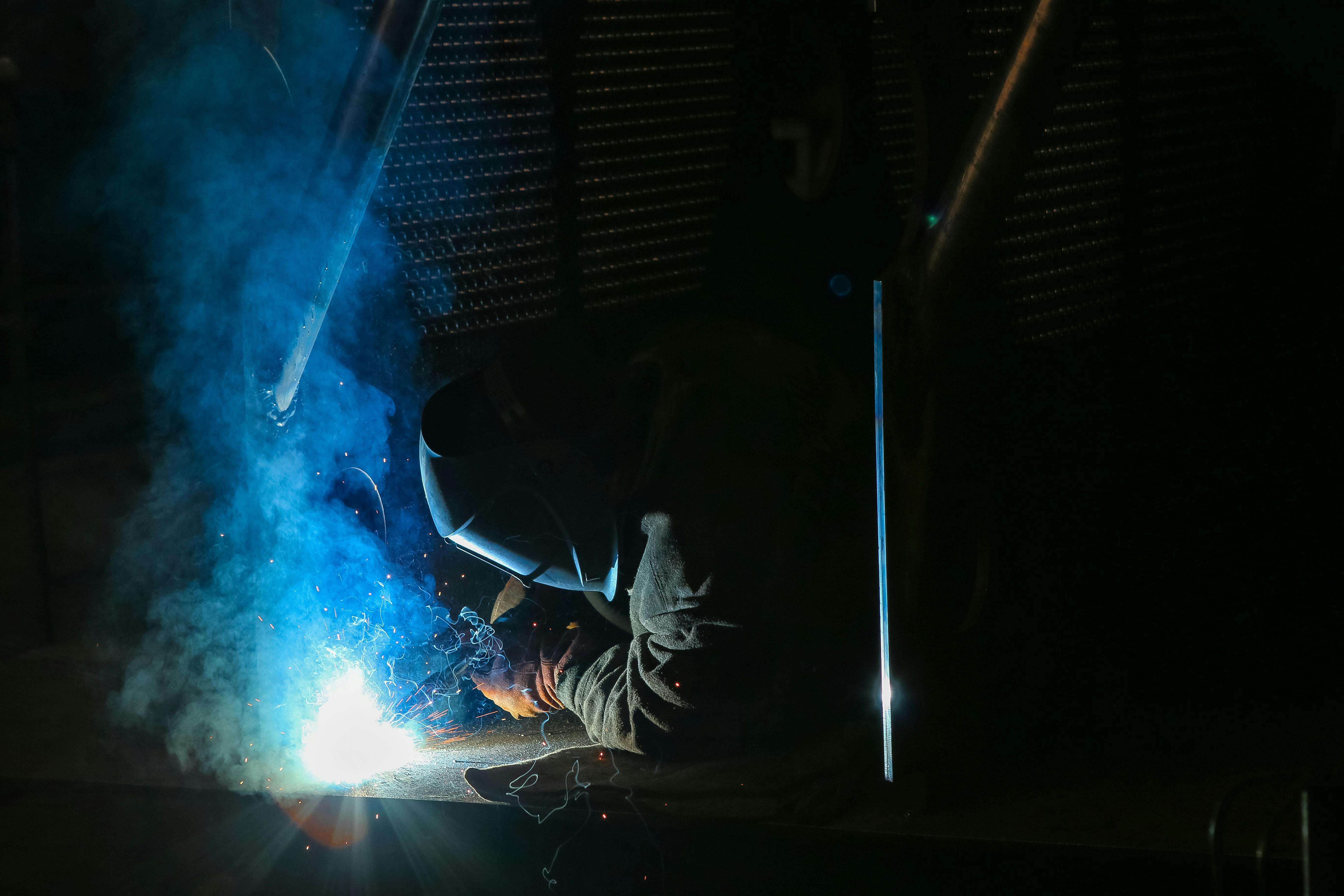
What Is Rope Access Welding at Height?
Rope access welding puts coded welders directly at the work face — on structural steel, pipework, vessels, and plant at height — without scaffolding. The welder is the access solution. They carry their welding equipment on ropes, set up at the joint, and produce welds to the same codes and quality standards as any workshop or ground-level fabrication.
This is not a compromise. A coded welder working from ropes produces the same quality of weld as one standing on a scaffold platform. The difference is in how they get there and what it costs. Eliminating scaffolding for localised welding tasks — a cracked bracket, a corroded handrail section, a leaking pipe support — saves significant time and money, particularly on industrial sites where scaffold erection requires permits, design calculations, and a dedicated erection crew.
The operators we connect you with employ dual-qualified technicians: IRATA-certified rope access professionals who also hold coded welder certifications to BS EN 9606 or ASME IX. These are not rope access people who have done a weekend welding course. They are experienced welders who have added rope access to their skill set, or vice versa — either way, they are fully competent in both disciplines.
Welding Processes From Rope Access
All the standard arc welding processes can be carried out from rope access. The choice of process depends on the application, the material, the position of the joint, and the specification:
MMA / Stick welding (SMAW) — the most portable and versatile process, and the most commonly used from ropes. The equipment is light, the consumables are compact, and it works in all positions. Stick welding is the default choice for structural steel repair, maintenance welding, and general fabrication at height. It is tolerant of less-than-perfect conditions — wind, surface contamination, and awkward positions — which makes it well suited to site work.
MIG / MAG welding (GMAW) — used where higher deposition rates are needed or where the specification calls for it. MIG welding from ropes requires a wire feeder and gas supply, which adds some equipment complexity, but it is routinely done. Particularly useful for longer runs of welding where stick welding would be slower — fillet welds on steelwork, for example.
TIG welding (GTAW) — for higher-quality welds on stainless steel, alloy pipework, and thin-wall materials. TIG welding from ropes is more demanding because it requires both hands plus a filler rod, but experienced rope access welders manage it effectively. Commonly used for process pipework tie-ins, small-bore pipe welding, and stainless steel fabrication.
Flux-cored arc welding (FCAW) — a wire-feed process that uses a flux-cored wire instead of solid wire with shielding gas. Self-shielded FCAW is particularly useful for outdoor work where wind would disperse a gas shield. It is widely used for structural steelwork and general fabrication from ropes.
Oxy-fuel cutting and heating — not welding, but frequently part of the same scope. Rope access technicians use oxy-fuel equipment for cutting steel, preheating joints before welding (where the procedure requires it), and flame straightening. The gas supply is managed from the ground with extended hose runs.
Plasma and disc cutting — for cutting thinner materials, making openings in steelwork, or removing damaged sections before repair. Battery-powered and pneumatic disc cutters are commonly used from ropes; plasma cutters require a power supply and compressed air but are still feasible for rope access work.
What Can Be Welded at Height?
The range of welding tasks carried out from rope access covers most of what you would find in an industrial maintenance or construction environment:
Structural steel repairs — cracked or corroded members, connection repairs, gusset plate replacement, stiffener installation, and splice repairs. These are often identified during inspection campaigns and repaired in the same mobilisation by the same team.
Pipework — small-bore and medium-bore pipe welding including branch connections, support brackets, pipe clamps, and pipework modifications. For coded pipe welding to PD 5500 or ASME standards, the welder qualification must cover the specific joint configuration, material, and position.
Handrails and guardrails — one of the most common rope access welding tasks. Damaged or corroded handrail sections are cut out and replaced, new handrails are fabricated in situ, and connections are rewelded. This is routine work for rope access welders on industrial sites and offshore installations.
Brackets, cleats, and supports — pipe supports, cable tray brackets, instrument supports, and equipment mounting brackets are frequently welded in position from ropes. The alternative — scaffolding the area to weld a single bracket — is disproportionately expensive.
Grating and chequered plate — replacement of corroded or damaged grating sections, chequered plate landing repairs, and nosing replacement. The existing section is cut out, the new section is offered up, and it is welded in position.
Platework — doubler plate installation, patch repairs on tanks and vessels (subject to engineering approval and repair procedure), and wear plate replacement. These tasks may require specific welding procedures and inspection after completion.
Lifting lugs and pad eyes — fabrication and installation of temporary or permanent lifting points. This is safety-critical welding that requires a specific welding procedure, qualified welders, and post-weld NDT inspection.
Welder Qualifications and Coding
Welder qualification is not optional in industrial welding. The welder must hold a valid approval certificate that covers the specific joint type, material, thickness range, welding position, and process for the work being carried out. The two main qualification standards are:
BS EN 9606 — the European standard for welder qualification testing. The standard is split by material type: Part 1 for steels, Part 2 for aluminium, and so on. A welder qualification test involves welding a test piece under examination conditions, which is then subjected to visual inspection, destructive testing (bend tests, macro examination), and sometimes radiography. The resulting certificate specifies exactly what the welder is qualified to do — material group, thickness range, joint type, welding position, and process.
ASME Section IX — the American standard, widely used in oil and gas, petrochemical, and pressure equipment sectors. ASME welder performance qualifications follow a similar principle: test piece, examination, and certification with defined ranges of qualification.
The welding itself is carried out to a Welding Procedure Specification (WPS), which is a document defining exactly how a specific joint should be welded — preheat temperature, interpass temperature, electrode type and size, travel speed, number of passes, post-weld heat treatment if applicable, and acceptance criteria. The WPS is supported by a Procedure Qualification Record (PQR) that proves the procedure produces an acceptable weld.
This documentation chain — qualified welder, approved WPS, supported by PQR — is the quality assurance framework for all structural and pressure-boundary welding. It applies equally whether the welder is standing on a scaffold or hanging on a rope.
Hot Work at Height
Welding at height introduces hot work hazards that need specific management. Sparks, slag, and molten metal fall downwards — and when you are welding at height, that means they fall onto whatever is below. On an industrial site, “below” might include process equipment, cabling, insulation, flammable materials, or people.
The controls for hot work from rope access include:
Hot work permits — issued under the site permit-to-work system. The hot work permit specifies the location, duration, fire precautions, and the area below that needs to be controlled. On most industrial sites, hot work permits require authorisation from the area authority and confirmation that the area has been checked for flammable materials and atmospheres.
Fire watches — a dedicated person stationed below the work area to monitor for fire, with appropriate fire extinguishing equipment immediately available. The fire watch must continue for a specified period after hot work ceases — typically 30 to 60 minutes — to catch any smouldering materials.
Spark containment — welding blankets, fire-retardant sheeting, and spark curtains are used to contain sparks and spatter. Rope access technicians deploy these from their working position, draping fire blankets over surfaces below the weld zone.
Atmospheric monitoring — in areas where flammable gases or vapours may be present, continuous gas monitoring is required before and during hot work. A gas-free certificate is typically issued as a prerequisite for the hot work permit.
One of the advantages of rope access welding is that the hot work zone is smaller and better defined than it would be with scaffolding. A scaffold platform creates a larger work area (and therefore a larger hot work zone), whereas a rope access welder occupies a precise position and can focus spark containment on a smaller area. This can actually reduce the overall hot work risk compared to scaffold-based welding.
In-Situ Fabrication
Not everything can be prefabricated at ground level and lifted into position. Sometimes the geometry, the access, or the interface with existing steelwork means that fabrication has to happen in place, at height. Rope access welders carry this out routinely.
Typical in-situ fabrication tasks include:
- Handrail fabrication where the route follows an irregular path around existing obstructions
- Structural modifications where new steelwork must interface with existing members at precise locations
- Pipe spool fabrication where the as-built geometry differs from the design drawings (which it usually does on older plant)
- Bracket and support fabrication where the attachment point is only accessible from ropes
In-situ fabrication requires more skill from the welder because there is no opportunity to rotate the work piece or choose an optimal welding position. The welder must be competent in positional welding — overhead, vertical up, and horizontal-vertical — which is why coded welder qualifications that cover all positions are essential.
NDT of Completed Welds
Structural and safety-critical welds require inspection after completion. The type and extent of inspection is specified in the welding specification or the project quality plan. Common post-weld inspection methods include:
- Visual inspection — every weld is visually inspected by the welder and, for critical welds, by an independent welding inspector (CSWIP 3.1 or equivalent)
- MPI (magnetic particle inspection) — for detecting surface and near-surface cracks in ferromagnetic welds. The most commonly specified volumetric test for structural fillet welds and butt welds
- DPI (dye penetrant inspection) — for non-magnetic materials (stainless steel, aluminium) or where MPI is impractical
- Ultrasonic testing — for detecting internal defects in butt welds. UT is specified for full-penetration butt welds on structural members, pressure-boundary welds, and coded pipe joints
- Radiography — for pressure-boundary welds and critical butt joints where the specification requires radiographic examination
When the welding is carried out by a rope access team, the post-weld NDT is often done by the same team — either by a dual-qualified welder/NDT technician or by a separate NDT technician within the rope access crew. This avoids the need for a second mobilisation and a second access setup purely for inspection.
Working in Hazardous and Confined Areas
Industrial welding at height frequently involves hazardous environments: ATEX zones, areas with residual hydrocarbons, confined spaces inside vessels and tanks, and locations adjacent to live plant. Rope access welders working in these environments hold the additional qualifications and follow the additional procedures required:
- ATEX/hazardous area awareness — understanding of zone classifications and the controls required for hot work in or near hazardous areas
- Confined space entry — City & Guilds 6150 or equivalent, with atmospheric monitoring and rescue standby provision
- Gas testing and monitoring — continuous atmospheric monitoring during hot work in any area where flammable gases could accumulate
Welding inside vessels and tanks is a particularly demanding scope that combines confined space entry, hot work management, atmospheric monitoring, and positional welding in an enclosed environment. Rope access techniques are often the most practical method of entry and egress for vertical vessels and columns, with the added benefit that the rope system doubles as a rescue and extraction system.
Why Scaffold-Free Welding Reduces Risk
There is a practical safety argument for carrying out welding from rope access rather than scaffolding, beyond the general safety record of rope access:
Smaller hot work zone — as discussed above, the defined hot work area around a rope access welder is smaller and more controlled than around a scaffold platform.
Less material to catch fire — scaffold boards and sheeting are a fire risk when hot work is taking place. There have been well-documented incidents of scaffold fires started by welding sparks. Rope access eliminates this material from the work area entirely.
Faster evacuation — a rope access technician can descend to ground level or a safe area in seconds using their abseil device. Evacuating from a multi-level scaffold in an emergency takes considerably longer.
Reduced congestion — scaffolding in congested plant areas can block access routes, obstruct emergency exits, and interfere with fire detection and suppression systems. Rope access avoids all of these issues.
These are real risk reduction benefits that support the ALARP case for using rope access over scaffolding for welding tasks — particularly on operating plant where the consequences of a fire are serious.
Typical Costs
Day rates for rope access welding vary depending on the qualification level, process, and complexity of the work:
- Rope access welder (coded, BS EN 9606): £400 to £600 per person per day, depending on the process and position qualifications required
- Rope access welder/fabricator (general fabrication, non-coded): £350 to £500 per person per day
- Team rate (2 welders + 1 IRATA Level 3 supervisor): £1,100 to £1,700 per day
Materials, consumables, and equipment (welding machines, gas, electrodes) are typically charged separately or included in an all-in project price.
The comparison with scaffold-based welding is the same as for other rope access disciplines: the trade labour cost is similar, but the access cost is dramatically lower. For a welding task that requires £3,000 of scaffold erection and strip, a rope access team can be set up and working in the time it takes to unload the first scaffold lorry.
Health and Safety
Welding from rope access combines the hazards of two disciplines — working at height and hot work — and the safety management needs to address both.
Expect the contractor to provide:
- IRATA safety management system with current audit certificate
- Coded welder certificates for all welders, covering the specific scope of work
- Welding Procedure Specifications (WPS) for all coded welding
- Hot work risk assessment and method statement
- COSHH assessments for welding fume exposure
- Fume extraction or RPE provision where required (welding fume is a Group 1 carcinogen — this is non-negotiable)
- Fire watch arrangements and equipment
- Site-specific documentation including permit-to-work compliance
On industrial sites with hazardous areas, additional documentation will include ATEX assessments, gas-free certificates, and isolation schedules for the hot work area.
Get a Quote
Our directory connects maintenance planners and project engineers with IRATA-certified rope access contractors who employ coded welders. The companies listed have experience across structural steel, pipework, and in-situ fabrication from ropes. Request a quote with details of your welding scope, materials, and applicable specifications, and we will match you with contractors who hold the right welder qualifications for the job.