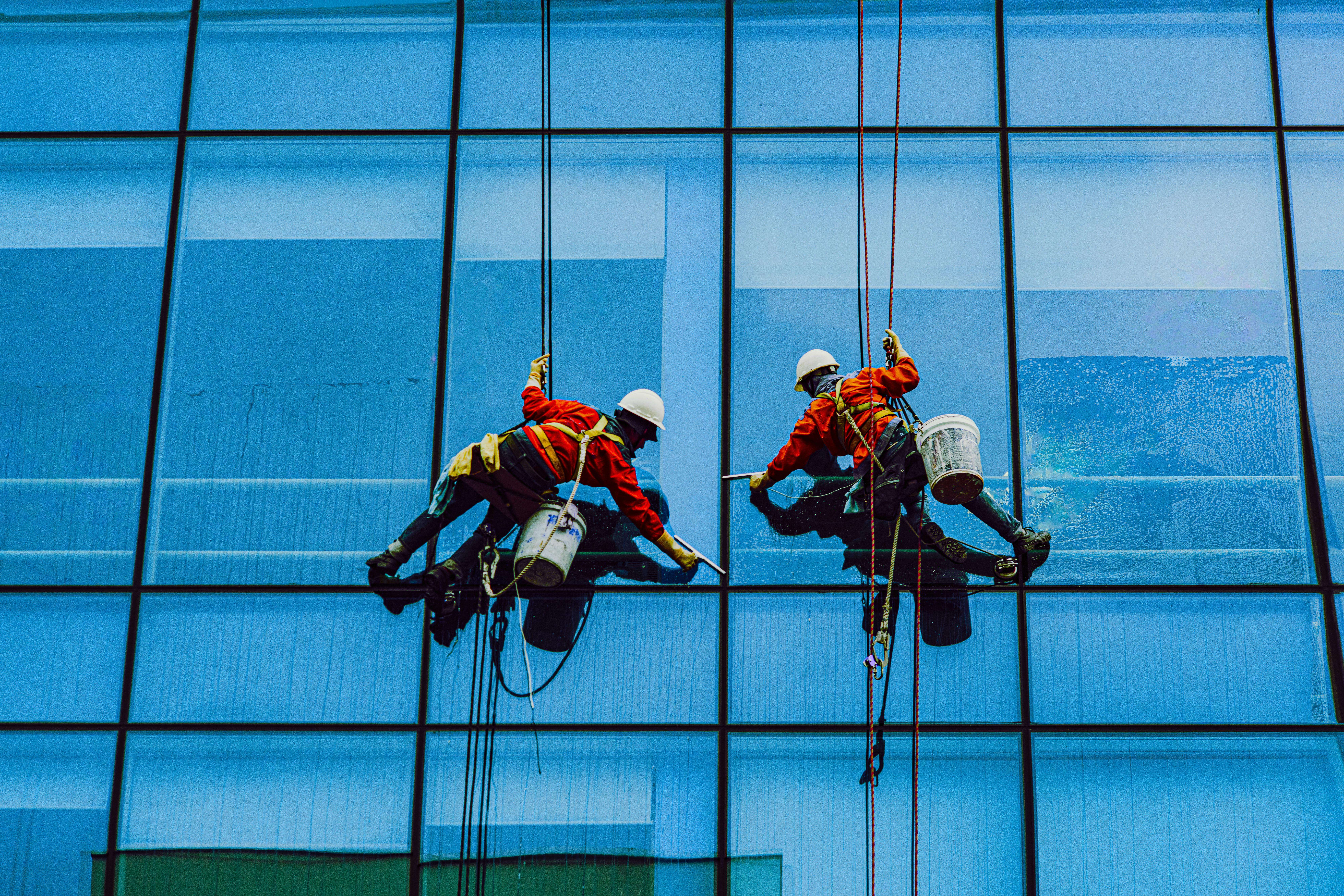
What is Rope Access Window Cleaning?
Keeping the glazing clean on a multi-storey commercial building is one of those maintenance tasks that sounds simple until you start pricing up access. Scaffolding takes weeks to erect and costs more than most annual cleaning budgets. Cradle systems are fine if your building was designed for one. Cherry pickers run out of reach somewhere around the sixth floor. Rope access solves all of that.
Working from twin-rope systems anchored at roof level, IRATA-certified technicians abseil down the facade carrying everything they need — squeegees, applicators, purified water systems, cleaning solutions — all secured to their harness or packed in tool bags. A team of two can typically clean the full exterior glazing of a ten-storey office block in a single day. The same job via scaffold involves days of erection and dismantling before or after a single day of actual cleaning.
Whether you need a one-off post-construction clean, a quarterly maintenance programme, or an emergency clean after neighbouring building work has coated your glazing in dust and cement, rope access is the practical, cost-effective answer for anything from four storeys up.
What Buildings Is It Suitable For?
Almost any building with exterior glazing above the reach of a water-fed pole — roughly 5 storeys and above — is a candidate for rope access cleaning. The technique doesn’t depend on ground conditions, vehicle access, or permanent infrastructure, which makes it unusually flexible.
Office buildings and commercial towers are the bread and butter of rope access window cleaning. Mid- and high-rise offices — anything from 4 to 40+ storeys — are ideal. Many modern commercial buildings were designed with rope access in mind, with davit bases or anchor points built into the roof structure during construction. For buildings without permanent anchors, temporary counterweight systems or structural anchors can be rigged before work begins.
Residential towers and apartment blocks present their own challenges: balconies, satellite dishes, and residents who are more sensitive to disruption than office workers. Rope access handles all of it. Technicians navigate around obstructions easily, cleaning individual panes without disturbing the people behind them. For social housing blocks and housing association properties, the cost difference versus scaffold is significant — rope access is typically significantly cheaper over a 12-month cleaning programme.
Retail and hospitality premises on busy high streets benefit from rope access in a specific way: it needs no ground space. There’s no need to close pavements, apply for a highway licence, or block customer entrances. The team rigs from the roof and works downward; pedestrians barely notice they’re there.
Industrial buildings, warehouses, and distribution centres often have high-level glazing panels, roof lights, and clerestory windows that are awkward to reach by any other means. Rope access technicians can rig off structural steelwork and access glazing at virtually any height or angle.
Heritage and listed buildings — churches, civic halls, listed offices, university buildings — often have complex architectural features that make scaffold expensive and intrusive. Rope access technicians can work around ornate stonework and narrow access points without the risk of scaffold poles or boards damaging historic fabric. For buildings managed under English Heritage, Historic Scotland, or Cadw guidelines, it’s frequently the preferred access method.
Internal atriums and glazed roofs are also well within scope. Hotel lobbies, airport terminals, glass-roofed shopping centres, and office reception areas often have large internal glazing that needs periodic cleaning. Rope access is commonly used for this work, usually scheduled out of hours when the space below is clear.
Where It’s Less Suitable
Rope access isn’t the right answer for every building. It’s generally not the most efficient solution for:
- Buildings of three storeys or fewer, where water-fed poles or cherry pickers are quicker and cheaper
- Buildings with no safe roof access at all, and no viable rigging points — rare, but it happens on some older structures
- Buildings with a functioning, well-maintained BMU (Building Maintenance Unit) that can reach all elevations — use the BMU; it’s there for a reason
- Internal glazing in spaces where anchor points cannot be rigged and MEWP access is practical
How It Compares to the Alternatives
This is where rope access earns its keep. The comparison isn’t even particularly close above four storeys.
| Method | Lead time | Suitable above 8 storeys? | Ground access required? | Relative cost |
|---|---|---|---|---|
| Rope access | Days | Yes | No | Lowest total cost for most buildings |
| Scaffolding | Weeks | Possible but rarely cost-effective | Yes (highway licence often needed) | Erection + dismantling alone can exceed a full year of rope access cleans |
| BMU / cradle | Weeks for temporary cradle | Yes | No | Only cost-effective if a permanent unit is already installed |
| Cherry picker (MEWP) | Days | Rarely above 6–8 storeys | Yes — solid, level ground essential | Requires ground access, traffic management, and is height-limited |
| Water-fed pole | Immediate | No — effective to ~5 storeys | Yes | Most affordable for low-rise only |
The cost difference is stark. Scaffolding a 10-storey building for a single clean typically costs £15,000–£30,000 once you account for erection, hire, and dismantling. The same building cleaned by rope access: £800–£2,500. That means you could run a full year of quarterly rope access cleans for less than the cost of putting scaffold up once.
Cherry pickers and water-fed poles work well on shorter buildings — up to five or six storeys — but they need solid, level ground and clear vehicle access. Once a building exceeds that height, or sits on a narrow street, or has no hardstanding, rope access is the only practical option that doesn’t involve scaffolding.
Temporary cradles are possible for buildings without a BMU, but they’re slow to set up and expensive to hire. Retrofitting a permanent BMU costs £50,000–£150,000 or more, which is only justifiable on large assets with a long lifecycle.
IRATA Levels and What They Mean for Your Job
IRATA — the Industrial Rope Access Trade Association — certifies technicians at three levels, and it’s worth understanding the difference because it directly affects pricing.
Level 1 (Rope Access Technician): Entry-level qualification. The technician can ascend, descend, traverse rope systems, carry out work at height, and perform basic rescues. Window cleaning is one of the more straightforward rope access tasks and sits comfortably within Level 1 competency.
Level 2 (Rope Access Technician — Advanced): Can carry out more complex rigging, perform advanced rescues, and supervise Level 1 technicians. Often leads a small window cleaning team.
Level 3 (Rope Access Supervisor): Plans and manages operations, writes risk assessments and method statements, and takes overall responsibility for site safety. Every rope access job — including window cleaning — should have a Level 3 involved in the planning stage, even if they’re not on the ropes for the cleaning itself.
For standard window cleaning, you’re typically looking at a team of two or three Level 1 technicians with a Level 2 or Level 3 supervising. Because the technical complexity is relatively low, window cleaning is one of the most affordable rope access services. You’re not paying for the specialist skills involved in, say, concrete repairs or NDT inspection. The pricing reflects that.
Some contractors run dedicated window cleaning teams who clean glass every day. These teams tend to be fast and produce consistent results because technique improves with repetition. Others rotate technicians across different types of work. Both approaches are valid — but if you’re running a regular programme on a complex facade, a dedicated team will usually be quicker and more thorough.
Cleaning Methods
Traditional squeegee and applicator — a strip applicator loaded with cleaning solution is drawn across the glass, followed by a squeegee in overlapping strokes, with edges detailed by scrim cloth. This is the method most commercial rope access cleaners use for standard glazing. It gives a streak-free finish and works well on most commercial glass types.
Pure water / deionised water systems — water filtered through a deionisation or reverse osmosis unit to remove all dissolved minerals. Pure water dissolves surface dirt, and because there are no minerals remaining, it dries without leaving spots or streaks. Some teams carry a small DI unit on the roof and feed a hose to technicians on the ropes; others use a van-mounted system. The advantage of pure water is that the finish stays cleaner for longer — no mineral deposits to attract further soiling. It’s particularly well-suited to buildings that are cleaned frequently.
Specialist treatments — for contamination that won’t shift with standard cleaning methods:
- Hard water staining and mineral deposits: mild acid-based solutions or cerium oxide polishing compounds
- Post-construction cleans: removing cement, mortar, plaster, paint, and adhesive residue using appropriate solvents and, where necessary, careful scraping with razor blades or specialist tools
- Restoration cleaning: for heavily neglected glass with years of build-up, which may require multiple treatment stages
Specialist cleans cost more than routine maintenance visits and may require more experienced technicians, but they can restore glass that the building owner had assumed would need replacing.
Pricing
Rope access window cleaning is priced either as a day rate for the team or as a fixed price per clean based on glazing area and complexity. For regular contracts, fixed pricing per clean is more common — it gives budget certainty and incentivises the team to work efficiently.
Day Rates
| Region | Two-person team | Three-person team |
|---|---|---|
| London and South East | £800–£1,200 | £1,100–£1,600 |
| Midlands | £600–£850 | £900–£1,200 |
| North of England | £600–£900 | £900–£1,300 |
| Scotland | £650–£900 | £900–£1,250 |
| Wales | £600–£800 | £850–£1,150 |
| Northern Ireland | £550–£750 | £800–£1,100 |
Day rates include rope access equipment, PPE, rigging, and standard cleaning consumables. Pure water system costs are usually included, but confirm this when requesting a quote.
Typical Per-Clean Prices
These are ballpark figures for standard external glazing — no specialist treatments, no internal work, no unusually complex access.
| Building type | Per clean (est.) |
|---|---|
| Small office block (4–6 storeys, standard elevations) | £400–£800 |
| Medium office block (8–12 storeys) | £800–£1,800 |
| Large commercial tower (15+ storeys) | £1,500–£4,000+ |
| Residential tower block | £600–£2,000 |
London pricing runs 20–40% higher than the national average due to London weighting on wages, congestion charges, parking, and the general overhead of operating in the capital. Northern Ireland is typically the most affordable market; the South East the most expensive.
What Moves the Price Up or Down
Building height: Taller buildings take longer because of the time spent ascending and descending, plus rope changeovers on very tall structures. A 20-storey building won’t cost twice a 10-storey building, but it will cost noticeably more.
Number of glazed elevations: A building with four fully glazed elevations costs more than one with two glazed elevations and two largely solid walls. Corner buildings and irregular footprints add rigging positions and time.
Facade complexity: Flat curtain walling is the fastest and cheapest facade to clean. Recessed windows, deep reveals, projecting mullions, brise soleil, and Juliet balconies all slow the process down.
Anchor point availability: Buildings with permanent roof anchors or davit sockets are cheaper to clean — rigging is quick. Buildings where the team must set up temporary counterweight systems each visit cost more; rigging time alone can add an hour or two per visit.
Roof access: Straightforward roof access via an internal staircase and roof hatch is ideal. If equipment has to come up through a plant room, over a parapet, or via a goods lift, it adds time.
Frequency: The more often you clean, the lower the per-clean cost. This isn’t just a volume discount effect — glass that’s cleaned regularly is faster to clean. A quarterly visit removes light soiling and takes less time per pane than an annual visit where the team is dealing with heavy build-up, staining, and possibly biological growth.
Ad-hoc vs contract: One-off cleans typically run 15–25% more expensive than the equivalent contracted rate. If you have a building that needs cleaning more than once a year, a contract almost always makes financial sense.
How Often Should Windows Be Cleaned?
There’s no universal answer, but here are the common frequencies and the situations they suit:
Monthly — premium city-centre office buildings, flagship retail, hotels, restaurants, and any building where appearance directly affects revenue or tenant retention. Monthly cleaning keeps the glass consistently presentable, and each individual clean is quick because there’s very little soiling between visits.
Quarterly — the most common frequency for standard commercial buildings. Four visits a year, typically timed around March, June, September, and December, keeps a building looking decent year-round. Many managing agents find quarterly is the minimum frequency before tenants start commenting.
Twice yearly — suitable for buildings in less prominent locations, industrial premises where appearance is secondary to function, and residential blocks with tight maintenance budgets. Spring and autumn is the typical schedule.
Annually — the bare minimum. Usually a spring deep clean to remove winter grime. Acceptable for warehouses, light industrial units, and buildings that aren’t public-facing. Annual cleans tend to take longer per pane because the soiling is heavier.
Factors That Affect the Right Frequency
- Location: Buildings near busy roads pick up traffic film quickly. Coastal buildings accumulate salt deposits. Buildings adjacent to construction sites need more frequent cleaning, and probably a post-construction specialist clean once the works are done.
- Surrounding environment: Nearby trees mean sap, pollen, and leaf residue. Bird roosts above window lines mean regular fouling on the glass below. Buildings downwind of industrial sites may need more frequent visits.
- Building use and tenant expectations: A solicitor’s office on a high street needs to look immaculate. A warehouse on a trading estate doesn’t. If you manage a multi-let building, check lease terms — some specify a minimum cleaning frequency.
Contract Options
Most rope access window cleaning companies will offer the following structures:
Ad-hoc / one-off cleans — no commitment. You request a quote, they clean. Useful for post-construction cleans, emergency visits, or trialling a new contractor. Expect to pay a premium over contracted rates.
Annual contracts with scheduled visits — the most common arrangement. Frequency is agreed upfront, visits are scheduled in advance, and you pay a fixed price per clean or a monthly retainer. This gives budget certainty and usually secures better rates than ad-hoc work.
Multi-year contracts — 2 or 3-year terms with annual price reviews. These lock in the best rates and guarantee continuity of service. The trade-off is reduced flexibility if the service isn’t delivering.
Framework agreements — used by organisations managing large property portfolios, allowing work to be called off at pre-agreed rates as needed. Common in the public sector and among large corporate occupiers.
Regional Availability
London and South East — the most competitive market in the UK. Dozens of rope access companies operate here, which means good availability but also a wide quality range. Some operators compete on price by reducing supervision or using less experienced teams. Always verify current IRATA membership and ask for recent references from comparable buildings. For work in the City or Canary Wharf, confirm your contractor is familiar with the specific security and access protocols for those areas.
Midlands — Birmingham, Coventry, Leicester, and Nottingham are well-served by both local companies and national operators with regional offices. Day rates are typically £600–£850 for a two-person team.
North of England — Manchester, Leeds, Liverpool, Sheffield, Newcastle, and surrounding areas have a healthy market, partly driven by the region’s industrial heritage. Many rope access companies here started in petrochemical, power, or offshore sectors and have expanded into building maintenance. Expect £600–£900/day, with Manchester and Leeds at the higher end. Rural areas in Northumberland, Cumbria, and North Yorkshire may attract travel charges.
Scotland — Edinburgh and Glasgow are well-served. Aberdeen has a particularly strong rope access market thanks to North Sea oil and gas, meaning no shortage of qualified technicians. The Central Belt has the best availability. For buildings north of Inverness or on the islands, operators willing to travel will charge a premium for travel time and accommodation.
Wales — Cardiff, Swansea, and Newport have reasonable availability at £600–£800/day. North Wales and rural areas are less well-served; companies may need to travel from the Midlands or North West.
Northern Ireland — Belfast has a growing rope access market at £550–£750/day. Outside Belfast, availability is limited and mainland companies may need to travel, which adds cost.
Health and Safety: What to Expect
As the person responsible for the building, you’re not expected to be a rope access expert. But you should know what documentation and on-site practice you’re entitled to expect.
Before Work Starts
A competent contractor should provide the following without being chased:
- Risk assessment and method statement (RAMS): Specific to your building, not a generic template. It should identify the hazards on your site — anchor point loads, edge protection, pedestrian management, weather limitations — and explain how the team will manage them.
- Proof of IRATA membership: The company should be a current IRATA member. Every technician on site should carry a valid IRATA ID card (photo, level, expiry date, valid for three years).
- Insurance certificates: Public liability insurance of at least £5 million for standard commercial work (£10 million for higher-risk sites), employers’ liability insurance (legally required), and professional indemnity where applicable.
- Equipment inspection records: All rope access equipment must be inspected by a competent person at least every six months, with records available on request.
On Site
- Every technician should be connected to two independently anchored ropes — a working rope and a safety rope. If you ever see a technician hanging from a single rope, stop the work immediately.
- The area directly below the working zone should be cordoned off to protect pedestrians from dropped tools or equipment.
- The team should have a clear communication system between technicians on the ropes and whoever is managing things at roof level.
- Work should stop automatically in high winds (typically above 25–30 mph, depending on the site), heavy rain, lightning, or ice. A professional team makes this call without being asked.
Every rope access job should have a documented rescue plan specific to your building. The basic principle is that any incapacitated technician must be reachable by another within minutes — which is why rope access teams always work in pairs at minimum.
Your responsibilities as building manager are to ensure the contractor has access to the roof, that the area below is managed appropriately, and that your building’s emergency procedures are shared with the contractor before work starts.
Environmental Considerations
Rope access has a smaller environmental footprint than most alternatives. A team arrives in a single van with ropes, harnesses, and cleaning kit — compare that to the multiple HGVs needed for scaffold delivery and collection, or the diesel crane for a temporary cradle.
Pure water systems use more water than squeegee cleaning — typically 50–100 litres per hour — but the runoff is essentially clean water with dissolved dirt, acceptable for surface water discharge in most circumstances. Where cleaning involves chemical treatments (acid washes, specialist stain removers), the contractor should have measures to contain and collect runoff, particularly near watercourses or in environmentally sensitive areas.
The industry trend is towards chemical-free cleaning using pure water systems, which is better for the environment and eliminates the risk of chemical damage to window frames, seals, and cladding. Where stronger chemicals are necessary, your contractor should provide COSHH assessments and confirm appropriate handling procedures.
Get a Quote
We connect you with IRATA-certified rope access window cleaning contractors across the UK. Fill in the form below and we’ll match you with vetted operators who have experience with your building type and work in your area. No obligation — most quotes can be provided based on building dimensions, photos, and a brief call, without a site visit for straightforward buildings.